RSS

Selling Below Assessed Value? Let's Put That Headline Into Perspective

You may have seen a recent headline reporting that three out of four homes sold in Metro Vancouver and the Fraser Valley this year have sold below their assessed value.

Sounds alarming, doesn't it?

But before drawing conclusions, there's something important to understand.

Those 2026 assessed values were established using market conditions as of July 1, 2025. That's nearly a year and a half ago!

And as we all know, a lot can change in the real estate market in that time.

According to the report, homes sold for an average of 4.6% below their assessed values. Does that mean those properties were sold for less than they were worth? Not necessarily.

It means we're comparing today's selling prices with valuations based on yesterday's market.

Now, there's no question that the market has softened. Buyers are more cautious, inventory is higher, and sellers have had to adjust their expectations. Those are genuine market conditions and we shouldn't ignore them.

But an assessed value is not the same as today's market value.

BC Assessment provides a valuation at a particular point in time, primarily for property taxation purposes. What a buyer is prepared to pay today depends on current comparable sales, competition, property condition, location and demand.

Here on the North Shore, we're seeing just how important those differences can be. Two seemingly similar properties can attract very different levels of interest depending on their pricing, presentation and individual characteristics.

Our takeaway? Don't let a headline tell you what your home is worth.

The real estate market is constantly changing and understanding what's happening right now is far more useful than comparing today's prices to a valuation from 16 months ago.

Whether you're buying, selling or simply keeping an eye on your property's value, context matters. And that's where good local market knowledge makes all the difference.

Read

Price Reduced! But Is It Really a Good Deal?

There's something about seeing a property advertised with a significant price reduction that gets buyers' attention.

A $50,000 reduction? Interesting. A $100,000 reduction? Now we're curious!

But before assuming you've found a bargain, there's an important question worth asking: Was the property ever worth its original asking price in the first place?

In today's North Shore real estate market, price reductions have become a familiar sight. And while some certainly represent opportunities for buyers, others simply reflect sellers adjusting expectations to meet the market.

So how do you tell the difference?

The Original Asking Price Isn't Necessarily the Starting Point

One of the biggest misconceptions about price reductions is that the amount reduced represents money saved.

Consider a home originally listed at $1,250,000 and subsequently reduced to $1,150,000.

On paper, that's a $100,000 reduction. But what if comparable properties have recently been selling for around $1,100,000?

Suddenly, that attractive price reduction doesn't look quite as compelling.

The asking price is what a seller hopes to achieve. Market value is what buyers are actually prepared to pay. And the two aren't always the same.

Comparable Sales Tell a More Useful Story

Before getting excited about a reduced price, we look closely at what similar properties have actually sold for.

That means considering location, size, age, condition, layout, exposure, parking and other features that influence value.

Here on the North Shore, two homes in the same neighbourhood — or even the same building — can command noticeably different prices.

A quiet, renovated south-facing condo with two parking spaces may appeal to a very different buyer pool than a similar-sized north-facing unit overlooking a busy street.

It's the details that matter.

What's Behind the Price Reduction?

A price reduction can tell us something about a seller's circumstances, but it doesn't tell the whole story.

Perhaps the home was initially priced too ambitiously. Perhaps another property has come onto the market at a more competitive price. Or perhaps the seller has a genuine reason to make a move sooner rather than later.

Understanding the property's listing history, current competition and seller's circumstances, where known, can help determine whether there's an opportunity to negotiate.

But we shouldn't assume that a seller who reduces their price is desperate to sell.

Don't Overlook the Condition of the Property

A reduced purchase price can quickly lose its appeal if substantial expenses are waiting around the corner.

For a detached home, that might involve the roof, drainage, heating systems or deferred maintenance.

For a condominium or townhouse, we'll want to understand the strata corporation's financial position, depreciation report, maintenance history and any significant upcoming projects.

A $40,000 price reduction might seem attractive until you discover a potentially expensive building repair or special levy.

Of course, those issues don't automatically make a property a poor purchase. They simply need to be understood and appropriately reflected in the price.

Sometimes a Price Reduction Really Does Create an Opportunity

There are situations where a seller adjusts their price to a level that represents excellent value compared with recent sales and competing properties.

Perhaps the home has been overlooked because its original price discouraged buyers. Perhaps the seller's timing has changed. Or perhaps the new price finally reflects the property's true position in the market.

These are the opportunities worth investigating.

Our Takeaway

A good deal isn't determined by how much the asking price has dropped. It's determined by what the property is worth today.

For buyers, the goal isn't simply to negotiate the biggest discount from the original list price. It's to purchase the right property, understand what you're buying and feel confident that the price makes sense.

And sometimes, the best opportunity isn't the property with the biggest red price-reduction banner. It's the one that was realistically priced from the beginning.

The Botto Team | Royal LePage Sussex

Helping buyers make informed real estate decisions throughout North Vancouver and West Vancouver.

Read

Should You Sell Now or Wait Until Spring 2027?

It's a question we hear from homeowners every year around this time.

"Would we be better off waiting until spring?"

And it's a perfectly reasonable question, particularly in a real estate market where buyers are cautious, properties are taking longer to sell and sellers are having to think carefully about their pricing strategies.

Spring has traditionally been considered the busiest real estate season. Gardens look their best, daylight hours are longer, and more buyers tend to be out looking at homes.

But does that automatically make spring the best time to sell?

Not necessarily. And in today's market, the answer deserves a little more thought.

More Buyers in Spring — But More Competition Too

One of the advantages of selling in spring is the potential for increased buyer activity.

Families may be planning moves around the school calendar, the weather is more inviting for viewings, and the fresh start of a new year often brings renewed interest in real estate.

However, there's another side to that equation.

Spring also tends to bring more listings.

That means your home could be competing with several similar properties in the same neighbourhood, building or price range.

A home that stands out in November because there are few comparable properties available might find itself competing with five or six alternatives come March or April.

More buyers don't necessarily mean a better result if those buyers also have more choices.

Less Competition Can Be an Advantage

One consideration that sellers sometimes overlook is the value of having fewer competing properties on the market.

Buyers don't stop looking for homes simply because the holiday season is approaching.

Some are relocating for work, some have already sold their homes, and others have been searching for months without finding the right property.

These buyers may have very real reasons to move.

If your home fills a gap in the current inventory — perhaps it's a well-maintained family home in a particular school catchment, or a desirable condo floor plan that's rarely available — there may be an opportunity to attract serious interest.

Of course, fewer buyers can also mean fewer showings and a longer selling period.

It's a trade-off worth considering.

What Does Waiting Actually Cost?

This is an important part of the conversation.

If you're thinking about delaying your sale by four or five months, consider the cost of maintaining the property during that time.

Mortgage interest, property taxes, insurance, utilities, strata fees and ongoing maintenance may all factor into the decision.

For a vacant property, these costs can be especially significant.

And if you've already purchased another home or are carrying two properties, waiting can create additional financial pressure.

That doesn't mean selling now is always the better choice. But the potential benefit of waiting should be weighed against the actual cost.

Will Prices Be Higher in Spring?

That's the question we'd all love to answer with certainty!

But markets don't follow a guaranteed seasonal pattern.

Interest rates, economic conditions, inventory, buyer confidence and changes in borrowing costs can all influence what happens between now and spring.

Waiting might work in your favour. Equally, market conditions could remain similar or become more challenging.

The important thing is not to base your decision on the assumption that spring will automatically bring higher prices.

A realistic assessment of your property's current value, recent comparable sales and likely competition will provide a better starting point.

Your Personal Timeline Matters

Real estate decisions aren't made in isolation from the rest of life.

Perhaps you're downsizing and looking forward to moving into a more manageable home.

Maybe a job change, retirement, family circumstances or an upcoming purchase is prompting your move.

Or perhaps you're simply exploring your options, with no particular deadline.

Those circumstances matter just as much as market statistics.

If selling now allows you to move forward with your plans and makes financial sense, there's no reason to delay simply because the calendar says November.

On the other hand, if there's no urgency and your home would benefit from some preparation, waiting until spring may be entirely sensible.

Preparation and Pricing Matter in Every Season

Whether you list in November or April, the fundamentals remain the same.

Buyers are looking carefully at value. They compare properties, consider condition and evaluate alternatives before making decisions.

A well-prepared home, supported by a thoughtful pricing and marketing strategy, has a better chance of attracting serious attention regardless of the season.

An overpriced property doesn't become more attractive simply because more buyers are out looking in the spring.

Our Takeaway

The best time to sell isn't necessarily the busiest time of year. It's the time that makes the most sense for your property, your circumstances and the market you're selling into.

For some North Shore homeowners, selling before the end of the year may offer an advantage because of limited competition.

For others, waiting until spring 2027 could be the more practical decision.

Rather than choosing a date based on tradition, we'd encourage you to look at the competing inventory, recent sales, likely selling costs and your own plans.

Because a well-informed decision is always better than simply hoping the next season will bring a better market.

The Botto Team | Royal LePage Sussex

Thoughtful real estate advice for North Vancouver and West Vancouver homeowners.

Read

North Vancouver Real Estate: Where the Opportunity Is This Fall

September’s numbers show a North Vancouver market that is giving buyers something they haven’t had much of in recent years: time and negotiating room.

Prices have softened across detached homes, condos and townhomes, while activity remains selective. Condos in particular are firmly favouring buyers, while detached homes and townhomes are closer to balanced conditions. North-Vancouver-September-Stats

The takeaway:

For buyers, more opportunity to compare properties, do proper due diligence and negotiate without the same pressure we saw in faster markets.

For sellers, homes are still selling — but buyers have choices. Pricing, condition, presentation and understanding your competition are vital.

And perhaps most importantly, there isn’t really one “North Vancouver market” right now. Conditions can look very different depending on whether you’re buying or selling a condo, townhome or detached house — and even from one neighbourhood or price range to another.

That’s where good market advice matters most.

Read

North Vancouver’s New Height Rules

A 9-part series - District of North Vancouver’s new residential zoning rules.

Part 3 of 9: Could Your Next North Vancouver Home Be Three Storeys?

If the District is discouraging deep underground basements, where does that living space go?

Increasingly, the answer may be up.

Under the new residential zoning rules, a principal house can generally be designed with as many as three storeys, with the storey count including applicable basement and attic living areas.

Maximum overall height will generally be:

  • 33 feet (10.1 metres) for a flat or very low-pitched roof

  • 38 feet (11.6 metres) for a qualifying pitched roof

There are additional height controls toward the front and rear portions of a property intended to reduce the impact of taller homes on neighbouring properties.

The result could be a gradual change in the way new detached homes in North Vancouver are designed.

Rather than putting significant living space underground, future homes may make greater use of above-ground floors.

What does this mean for my property?

If you are considering rebuilding, don't assume your future home needs to follow the same basic shape as the house currently sitting on the lot.

A three-storey design may provide different options for bedrooms, family areas, views and multigenerational living.

But being permitted to build taller does not necessarily mean you can build a substantially larger house. Overall floor-area limits still apply.

Height, floor area, setbacks, slope and neighbouring properties all work together in determining what can actually be built.

And there is another potentially valuable opportunity under the new zoning — particularly for R2 properties.

Next week: Could You Build a 1,400 Sq. Ft. Coach House on Your Property?

This article is a general summary and is not intended as legal or planning advice. Property-specific requirements should always be confirmed with the District of North Vancouver.

Read

Buyers Compare Your Home Before They Decide Its Value

Why Sellers and Buyers Often See Value Differently

When homeowners think about the value of their property, it is natural to start with what they paid, how much they have invested in renovations, or what a nearby home sold for last year.

Buyers tend to look at value very differently.

They are comparing your home with what else they can buy today.

That distinction is important.

A seller may be thinking:

  • We paid $X for the home.

  • We spent $150,000 renovating it.

  • The neighbour sold for $X last year.

  • We need a certain amount in order to make our next move.

All of those things matter personally and financially. But they do not necessarily determine current market value.

Buyers Compare — They Don’t Calculate Your Costs

When a buyer walks through your home, they are usually comparing it with the other properties they have recently viewed.

They are asking questions such as:

How does the location compare?
Is the home renovated or will it require work?
How functional is the floor plan?
What is the exposure and natural light like?
How large is the lot?
What condition is the home in?
How does the price compare with similar properties currently available?

In other words, buyers are not usually calculating what the seller has invested. They are deciding whether the home represents good value relative to their other choices.

Renovations Add Value — But Not Always Dollar for Dollar

Renovations can absolutely make a property more appealing and more valuable.

A thoughtfully renovated kitchen, updated bathrooms, new windows, improved mechanical systems or a well-designed outdoor space can all influence how buyers perceive a home.

But renovation costs do not automatically translate directly into resale value.

A seller may spend $100,000 on improvements without increasing the market value by exactly $100,000. Some improvements appeal to a broad range of buyers, while others are highly personal.

Condition, quality, design, timing and buyer demand all play a role.

Last Year’s Sale Is Not Today’s Market

Another common reference point is a neighbour’s sale.

Comparable sales are extremely useful, but context matters.

A sale from six or twelve months ago may have occurred under very different conditions — with fewer homes available, more buyer competition, different interest rates or different momentum in the market.

Even two homes on the same street can perform differently because of lot size, renovations, exposure, floor plan, view, parking, condition or location within the block.

The most relevant question is not simply:

“What did the neighbour sell for?”

It is:

“How does my home compare with the alternatives buyers have right now?”

Pricing Is About Positioning

A successful pricing strategy is not just about choosing a number.

It is about positioning your property within the current market so buyers see it as one of the strongest choices available in its category.

Price too high, and buyers may simply choose the competing property down the street.

Price appropriately, present the home well and market it effectively, and you create a much better opportunity for buyers to engage.

That is why we look at more than historical sales when evaluating a property. We also consider current competition, recent buyer behaviour, days on market, neighbourhood trends and how the home compares in terms of condition, layout, location and overall presentation.

The Market Ultimately Sets the Value

Sellers determine the asking price.

Buyers determine whether that price makes sense.

The strongest results tend to happen when those two perspectives are brought together — using good market evidence, realistic positioning and a clear understanding of what buyers are comparing.

If you are considering selling, understanding how buyers are likely to view your home can be just as important as knowing what similar homes have sold for.

Read

What We’re Watching as the Fall Market Begins

The Bank of Canada has held its policy rate at 2.25%, bringing some stability as we head into the fall real estate market. But interest rates are only one part of the picture.

September often brings a little more energy back to the market as summer holidays wind down and people return to their regular routines. More activity, however, does not necessarily mean a dramatically different market.

For sellers: More buyers may return this fall, but they remain selective. Preparation, presentation and accurate pricing will continue to matter. Buyers need to see the value.

For buyers: Greater selection and less urgency can work in your favour. You may have more time to compare homes, complete your due diligence and negotiate thoughtfully. If the right property appears, waiting for rates or the market to change may not necessarily produce a better opportunity.

For homeowners thinking about moving: You don’t need to know exactly when you’ll make a move to start preparing. Understanding what your current home may be worth, what your next home could cost and what needs to happen before selling can make the eventual transition much easier.

Here in North Vancouver and across the North Shore, conditions can vary considerably by property type, price range and neighbourhood. A condo in Lower Lonsdale may be experiencing a very different market from a detached home in Lynn Valley, Edgemont Village or Deep Cove.

Rather than trying to predict the next interest rate move or the perfect time to buy or sell, we encourage clients to focus on the market we actually have and make decisions based on their own timing and goals.

September feels like a fresh start. Whether you’re planning to buy, sell or simply keeping an eye on the market, it’s a good time to get informed, get prepared and be ready when the right opportunity presents itself.

Wondering what today’s North Vancouver or North Shore market means for you? The Botto Team is always happy to help you look at the numbers and understand your options.

Read

What “World Uncertainty” Actually Does to Real Estate

When there’s broader uncertainty—economic, political, interest rates, global events—it doesn’t eliminate demand. It recalibrates confidence.

On the ground, that shows up as:

· More cautious buyers
They take longer, analyze more and feel less urgency.

· Fewer impulsive decisions
The “I need to win this at any cost” mindset (2021–2022) fades.

· Greater price sensitivity
Buyers become more disciplined about value and comparables.

· Longer days on market
Not because homes aren’t desirable—but because decisions take longer.


Why the North Shore Still Holds Strong

The North Shore isn’t a speculative market—it’s a lifestyle-driven market.

People still want:

· Access to nature

· Strong schools

· Community feel

· Proximity to the city

That underlying demand doesn’t disappear. It pauses, reshapes and re-enters more thoughtfully.

So yes—homes are still selling every day. But they’re selling under different conditions:

· Well-priced homes → still move

· Well-presented homes → still attract attention

· Unique or scarce product → still performs strongest


The Post-COVID Hangover (2021–2022 Effect)

This is one of the biggest psychological factors right now.

That market was:

· Ultra-low rates

· Extremely limited inventory

· Emotion-driven bidding wars

· Speed over analysis

Today’s market is:

· Rate-aware

· Data-driven

· Choice-heavy (and growing)

· More balanced—or even buyer-leaning at times

The gap between expectation and reality is where friction lives.

Sellers remember peak pricing.
Buyers remember overpaying fears.
And both are trying to recalibrate.


What Actually Works in This Market

This is where your philosophy is spot on—and worth reinforcing:

A successful transaction today comes down to alignment:

· Timing: Does the move make sense for your life?

· Financial comfort: Can you carry it confidently?

· Product quality: Is the home desirable in today’s lens?

· Strategy: Is pricing and presentation grounded in today’s market—not yesterday’s?

When those line up, the market becomes far less intimidating.


The Long-Term Lens

Real estate—especially on the North Shore—is not a short-term trade.

If someone is:

· Buying and holding

· Making a lifestyle move

· Improving their day-to-day living

· Stepping into the right property for their needs

Then short-term market fluctuations matter far less.

Uncertainty creates hesitation—but it also creates opportunity for thoughtful decisions.


Bottom Line:

People still want to live on the North Shore—and that hasn’t changed. What has changed is how they’re making decisions.

We’ve moved from a fast, emotional market to a more thoughtful, measured one. Homes are still selling every day—but pricing, presentation and timing matter more than ever.

If a move makes sense for your life, your goals and your finances—and you’re focused on the long term—it’s still a very good time to buy or sell. The strategy just needs to match the moment.

Read

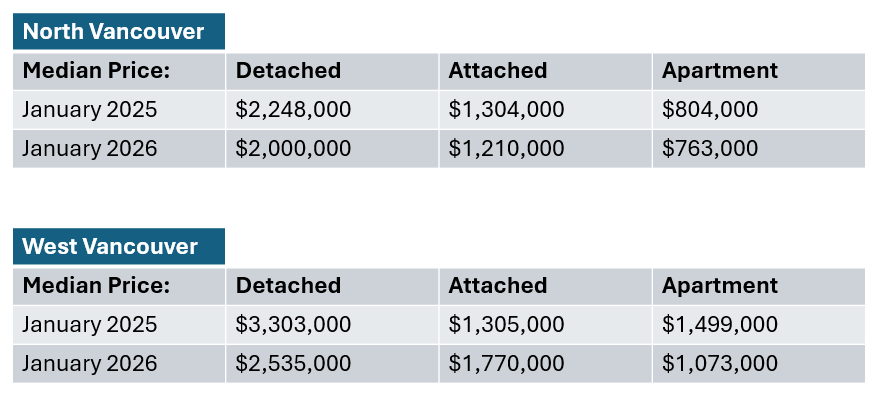
Is it a Good Time to Buy?

Posted 5-year Mortgage Rates:

January 2025: 6.79%
January 2026: 4.56%

Savings per $100K per month: $130.69

2025 Year-End Market Insights

Bottom Line

For many buyers, especially financially qualified ones, the North Shore is currently a favourable market to buy because:

  • Inventory is elevated and sales are below historical norms, creating buyer leverage.

  • Prices have softened or stabilized compared with recent highs.

  • Mortgage rates are more predictable and lower than in the past year.

  • Forecasts suggest modest market improvement ahead, so buying before broad demand re-emerges may be advantageous.

Read
Categories:   #IMHOME CONTEST | Aluminum Wiring | Ambleside, West Vancouver Real Estate | Annual Pumpkin Patch | Bank of Canada | BC Assessment | BC Real Estate | Blueridge NV, North Vancouver Real Estate | Boulevard Real Estate | Buyers | Buying a Home | canuck place adventure challenge | Capilano NV, North Vancouver Real Estate | Central Coquitlam, Coquitlam Real Estate | Central Lonsdale, North Vancouver Real Estate | City of North Vancouver | Coal Harbour, Vancouver West Real Estate | Common Property | Condo | conquer cancer lynn valley, ride to conquer cancer | Deep Cove, North Vancouver Real Estate | District of North Vancouver | Dollarton, North Vancouver Real Estate | Downtown VW, Vancouver West Real Estate | Dundarave, West Vancouver Real Estate | Energy Efficiency | False Creek North, Vancouver West Real Estate | Family Activities | First-Time Buyers | Forest Hills NV, North Vancouver Real Estate | Grouse Woods, North Vancouver Real Estate | Hamilton, North Vancouver Real Estate | Heat Pumps | Heritage Woods PM, Port Moody Real Estate | Home Buyer Programs | Home Inspections | Home Insurance | Home Maintenance | Home Owner Grant | Home Staging | Home Values | Homeowners | Homeowners, | Housing Policy | Indian River, North Vancouver Real Estate | interest rates | Investment Property | Kids Activities | Lions Bay, West Vancouver Real Estate | live in lynn valley | Local Events | Lower Lonsdale, North Vancouver Real Estate | Lynn Valley, North Vancouver Real Estate | Lynnmour, North Vancouver Real Estate | Maintenance Fees | Market Updates | Metro Vancouver Real Estate | Mortgage Rates | Mortgage Renewal | Multi Generational Living | Municipality | New Construction | North Shore Community | North Shore Living | North Shore Real Estate | North Vancouver | North Vancouver Events | North Vancouver Real Estate | North Vancouver Zoning | Northlands, North Vancouver Real Estate | Oil Tank Removal | permits | Preparing to Sell | Preparing to Sell, Home Staging | Pricing Strategy | Princess Park, North Vancouver Real Estate | Property Taxes | Property Values | pumpkin patch 2012 | Queensbury, North Vancouver Real Estate | R1 Zoning | R2 Zoning | Real Estate | Renfrew VE, Vancouver East Real Estate | Rental Income | Roche Point, North Vancouver Real Estate | Sellers | Selling a Home | Seniors | Spring Market | Strata | Strata Lot | Strata Property Act | Tempe, North Vancouver Real Estate | Unit Entitlement | Upper Lonsdale, North Vancouver Real Estate | Westlynn Terrace, North Vancouver Real Estate | Westlynn, North Vancouver Real Estate
Reciprocity Logo The data relating to real estate on this website comes in part from the MLS® Reciprocity program of either the Greater Vancouver REALTORS® (GVR), the Fraser Valley Real Estate Board (FVREB) or the Chilliwack and District Real Estate Board (CADREB). Real estate listings held by participating real estate firms are marked with the MLS® logo and detailed information about the listing includes the name of the listing agent. This representation is based in whole or part on data generated by either the GVR, the FVREB or the CADREB which assumes no responsibility for its accuracy. The materials contained on this page may not be reproduced without the express written consent of either the GVR, the FVREB or the CADREB.