RSS

What We’re Watching as the Fall Market Begins

The Bank of Canada has held its policy rate at 2.25%, bringing some stability as we head into the fall real estate market. But interest rates are only one part of the picture.

September often brings a little more energy back to the market as summer holidays wind down and people return to their regular routines. More activity, however, does not necessarily mean a dramatically different market.

For sellers: More buyers may return this fall, but they remain selective. Preparation, presentation and accurate pricing will continue to matter. Buyers need to see the value.

For buyers: Greater selection and less urgency can work in your favour. You may have more time to compare homes, complete your due diligence and negotiate thoughtfully. If the right property appears, waiting for rates or the market to change may not necessarily produce a better opportunity.

For homeowners thinking about moving: You don’t need to know exactly when you’ll make a move to start preparing. Understanding what your current home may be worth, what your next home could cost and what needs to happen before selling can make the eventual transition much easier.

Here in North Vancouver and across the North Shore, conditions can vary considerably by property type, price range and neighbourhood. A condo in Lower Lonsdale may be experiencing a very different market from a detached home in Lynn Valley, Edgemont Village or Deep Cove.

Rather than trying to predict the next interest rate move or the perfect time to buy or sell, we encourage clients to focus on the market we actually have and make decisions based on their own timing and goals.

September feels like a fresh start. Whether you’re planning to buy, sell or simply keeping an eye on the market, it’s a good time to get informed, get prepared and be ready when the right opportunity presents itself.

Wondering what today’s North Vancouver or North Shore market means for you? The Botto Team is always happy to help you look at the numbers and understand your options.

Read

Should I Sell Now — or Wait?

Five questions worth asking before you decide.

“Maybe we’ll just wait until the market gets better.”

We are hearing some version of this from a lot of homeowners right now.

And it is an understandable thought. Buyers have more choice, homes are taking longer to sell in some segments and prices have softened from previous highs.

But before deciding to wait, there is another question worth asking:

What exactly are you waiting for?

Trying to perfectly time the bottom — or the top — of a real estate market is almost impossible. We usually only recognize those moments after they have passed.

So rather than trying to predict what the market may do six months from now, I think there are some better questions to ask.

Why are you thinking about moving?

If the idea of selling is being driven by a change in your life — downsizing, needing more space, a job change, family circumstances, finances or simply wanting something different — it is worth considering how important that move is to you.

Real estate decisions are not made on a spreadsheet alone.

Your life has a timeline too.

Waiting may absolutely make sense, but putting a plan on hold indefinitely in the hope of a better market is not always the best answer either.

What are you buying next?

This is one of the most important parts of the equation and one homeowners sometimes overlook.

If you are selling and buying in the same market, a softer market can work both ways.

You may receive less for your current home than you would have at the height of a strong seller’s market, but you may also have more choice, less competition and greater negotiating power when you buy.

The number that matters is not always simply what you sell for.

It is the difference between what you sell for and what you have to pay for the next home.

For someone moving up, downsizing or changing neighbourhoods, that gap can sometimes matter far more than the sale price on its own.

What is happening with homes like yours?

Real estate is extraordinarily local.

The market for a renovated two-bedroom condo in Lower Lonsdale can behave very differently from the market for a detached home elsewhere on the North Shore.

Before deciding whether to sell now or wait, I would want to know:

  • What similar homes are currently for sale?

  • What has actually sold recently?

  • How long are those homes taking to sell?

  • Have sellers had to reduce their prices?

  • What are buyers choosing — and what are they passing over?

  • Where would your home realistically sit amongst those options?

That tells us far more than a headline about “the market.”

Buyers today have more opportunity to compare. As a result, the difference between the homes they respond to and those they pass over has become much more noticeable.

Condition, presentation and especially price matter.

What would have to improve for waiting to be worthwhile?

This is perhaps the most useful question of all.

Are you waiting for prices to rise?

For interest rates to fall?

For there to be fewer competing listings?

For your own circumstances to change?

Once you define what you are actually waiting for, it becomes much easier to decide whether waiting is a strategy — or simply uncertainty.

The market may improve six months from now. It may also remain relatively flat, or your particular type of property may behave differently from the broader market.

We simply do not know.

What we can know is what your home is likely worth today, what you would be competing against, what your next purchase might cost and whether the overall move works for you.

So, should you sell now?

For some people, yes.

For others, I would tell them to wait.

The answer depends on your property, your financial position, what you hope to buy next and, most importantly, why you are considering moving in the first place.

My job is not to convince you that now is always the right time to sell.

It is to give you a clear picture of what your home is likely worth today, what is happening with comparable properties and what the opportunities and risks look like on both sides of your move.

From there, you can make a decision based on good information rather than trying to predict the market.

And sometimes, after looking at all of that, the right advice really is:

Not yet.

Read

What this means for sellers

You’re in a balanced market—but strategy matters more than ever
At ~14% sales ratio, homes are selling—but not automatically.
Buyers are selective, and pricing needs to be dialed in from day one.

Overpricing will cost you momentum
With more inventory and cautious buyers, listings that miss the mark risk:

  • Sitting longer

  • Getting overlooked entirely

  • Requiring price adjustments later

Detached sellers may have an edge (for now)
Fewer new listings + rising sales = a window of opportunity.
Well-priced detached homes—especially good product—can still perform strongly.

Apartments & townhomes require sharper positioning

  • Slower sales activity

  • More competition

Presentation, pricing and timing matter more in these segments

Read

What this means for buyers

More choice, less urgency
Inventory is up (well above the 10-year average), and sales are below normal levels. That gives buyers more options and time to make decisions—less of the pressure we saw in past spring markets.

Negotiation is back (in pockets)
With the sales-to-active listings ratio at 14.2%, we’re in balanced market territory—but leaning softer. Especially in apartments and attached homes, buyers have more leverage.

Detached may tighten
This is the interesting shift:

  • Detached sales up 8.3%

  • New listings down

That combination can create competition in select detached properties, even while the broader market feels calm.

Pricing isn’t falling fast—but it’s softer year-over-year
Prices are down ~6–8% from last year, but relatively stable month-to-month. Translation:

  • No sharp “deals” across the board

  • But better value than a year ago

Read

Buyers and sellers adopting a wait-and-see approach to housing market

Metro Vancouver home sales are moving at a pace similar to last year, dipping roughly three per cent compared to March 2025. According to Greater Vancouver REALTORS®, 2,032 homes sold in March 2026—2.8 per cent fewer than last year and well below the 10-year average of 2,981.

Big picture (what’s really going on)

  • Buyers are watching external factors (rates, global uncertainty)

  • Sellers are hesitating to list

  • The result: a steady but cautious market

Prices aren’t moving dramatically because:

  • Demand is softer

  • But supply isn’t flooding the market either

Simple summary

  • Buyers: more choice, some negotiating power, but act decisively on the right property

  • Sellers: homes are selling, but only with sharp pricing and strong presentation

  • Market tone: balanced, cautious, with early signs of strength in detached

With inventory up and demand steady, it’s a market that rewards preparation, patience and good advice.

Read

What “World Uncertainty” Actually Does to Real Estate

When there’s broader uncertainty—economic, political, interest rates, global events—it doesn’t eliminate demand. It recalibrates confidence.

On the ground, that shows up as:

· More cautious buyers
They take longer, analyze more and feel less urgency.

· Fewer impulsive decisions
The “I need to win this at any cost” mindset (2021–2022) fades.

· Greater price sensitivity
Buyers become more disciplined about value and comparables.

· Longer days on market
Not because homes aren’t desirable—but because decisions take longer.


Why the North Shore Still Holds Strong

The North Shore isn’t a speculative market—it’s a lifestyle-driven market.

People still want:

· Access to nature

· Strong schools

· Community feel

· Proximity to the city

That underlying demand doesn’t disappear. It pauses, reshapes and re-enters more thoughtfully.

So yes—homes are still selling every day. But they’re selling under different conditions:

· Well-priced homes → still move

· Well-presented homes → still attract attention

· Unique or scarce product → still performs strongest


The Post-COVID Hangover (2021–2022 Effect)

This is one of the biggest psychological factors right now.

That market was:

· Ultra-low rates

· Extremely limited inventory

· Emotion-driven bidding wars

· Speed over analysis

Today’s market is:

· Rate-aware

· Data-driven

· Choice-heavy (and growing)

· More balanced—or even buyer-leaning at times

The gap between expectation and reality is where friction lives.

Sellers remember peak pricing.
Buyers remember overpaying fears.
And both are trying to recalibrate.


What Actually Works in This Market

This is where your philosophy is spot on—and worth reinforcing:

A successful transaction today comes down to alignment:

· Timing: Does the move make sense for your life?

· Financial comfort: Can you carry it confidently?

· Product quality: Is the home desirable in today’s lens?

· Strategy: Is pricing and presentation grounded in today’s market—not yesterday’s?

When those line up, the market becomes far less intimidating.


The Long-Term Lens

Real estate—especially on the North Shore—is not a short-term trade.

If someone is:

· Buying and holding

· Making a lifestyle move

· Improving their day-to-day living

· Stepping into the right property for their needs

Then short-term market fluctuations matter far less.

Uncertainty creates hesitation—but it also creates opportunity for thoughtful decisions.


Bottom Line:

People still want to live on the North Shore—and that hasn’t changed. What has changed is how they’re making decisions.

We’ve moved from a fast, emotional market to a more thoughtful, measured one. Homes are still selling every day—but pricing, presentation and timing matter more than ever.

If a move makes sense for your life, your goals and your finances—and you’re focused on the long term—it’s still a very good time to buy or sell. The strategy just needs to match the moment.

Read

Don’t Let Headlines Decide Your Real Estate Decisions

If you’ve glanced at the news lately, you’ve likely seen a wave of unsettling real estate headlines—stories about market “malaise,” pressure on buyers, declining sales, and even predictions of a looming crash. In a single day, it’s not unusual to see multiple headlines painting a discouraging picture.

But here’s the reality: headlines are designed to grab attention—not to guide your personal decisions.

The media thrives on extremes. Negative narratives create urgency and fear, and in doing so, they often amplify noise rather than provide meaningful clarity. What gets lost in the process is context—your context.

Yes, the market has shifted. We’ve moved from the frenzied “fear of missing out” we saw during the height of the pandemic—when inventory was scarce and competition fierce—to a more cautious, thoughtful mindset. Buyers today are focused on making the right move at the right time.

And that makes sense.

Inventory levels have risen. The cost of living remains high. Inflation and global uncertainty are part of everyday conversation. According to a recent RBC poll, more than half of British Columbians are consistently thinking about whether they can afford a home. Yet despite these concerns, the desire for homeownership remains strong—because owning a home still represents stability, pride, and long-term security.

So what does all of this mean?

It means the “right time” to buy or sell has very little to do with headlines—and everything to do with your goals.

In fact, today’s market conditions can be quite favourable for buyers in certain segments. For example, the North Vancouver apartment market is currently offering more choice and less competition than we’ve seen in years. For someone with a long-term outlook, this could present a meaningful opportunity.

At the same time, even a “perfect” market doesn’t make it the right moment if it doesn’t align with your personal circumstances.

That’s the key: real estate is not one-size-fits-all.

Your timing depends on your life, your finances, your plans, and your comfort level—not on a national headline or a generalized market prediction.

So rather than getting caught up in the noise, take a step back and ask yourself:

  • What am I trying to achieve?

  • What does the next chapter look like for me?

  • How does real estate support that vision?

From there, the conversation becomes much clearer.

If you’re curious about what’s actually happening in our local market—and how it aligns with your goals—it’s worth having a conversation with a trusted real estate professional. Not to react to fear, but to make informed, confident decisions.

Because in the end, the best real estate decisions aren’t driven by headlines.

They’re driven by you.

Read

What BC’s 2026 Budget Could Mean for Housing — and for Homeowners

The provincial government released BC Budget 2026 in mid-February, and while budgets rarely make for light reading, this one carries some important implications for housing across British Columbia.

For homeowners, buyers, and anyone watching the real estate market closely, several of the measures introduced this year raise broader questions about affordability, housing supply, and the long-term direction of policy in our province.

A Budget Introduced in a Challenging Economic Moment

The budget arrives at a time when the provincial economy is facing uncertainty and slower growth. As expected in that environment, the government has projected a sizable deficit.

While deficits themselves are not unusual during uncertain economic cycles, economists have pointed out that the budget does not yet outline a clear path to returning the province’s debt levels to a more sustainable trajectory. Over time, rising debt-service costs can reduce the government’s flexibility — limiting its ability to provide tax relief or fund new initiatives.

For those of us who work closely with housing every day, the bigger question is how policy decisions today shape the future supply of homes across the province.

The Supply Question: A Key Concern

One of the central challenges in British Columbia’s housing market remains housing supply. Population growth continues, while new home construction has already begun to slow in some areas due to rising costs and economic uncertainty.

The concern expressed by industry economists is that several measures introduced in the budget may further increase the cost of building new homes — at a time when encouraging development is widely viewed as critical to improving long-term affordability.

According to BC Real Estate Association Chief Economist Brendon Ogmundson:

“There is unfortunately not a lot to like from either a macroeconomic or housing perspective in this budget… doing so on the back of an already struggling housing sector will ultimately prove to be self-defeating.”

Key Measures That Affect Real Estate

Several policy changes introduced in the budget directly affect those who own property, develop housing, or invest in residential real estate.

1. Higher Additional School Tax on Higher-Value Homes
Beginning in 2027, the province will increase the Additional School Tax applied to residential properties assessed above $3 million.

The new rates will be:

0.3% (up from 0.2%) on assessed value between $3M–$4M

0.6% (up from 0.4%) on assessed value above $4M

This tax applies to most residential property types including detached homes, townhomes, condominiums, and vacant residential land. For mixed-use buildings, it only applies to the residential portion of the assessed value.

On the North Shore — where property values frequently cross the $3M threshold — this change is likely to affect a meaningful number of homeowners over time.

2. Speculation and Vacancy Tax Increase
The Speculation and Vacancy Tax will also increase beginning in 2027.

For foreign owners and untaxed worldwide earners, the tax rate will rise from 3% to 4% on the assessed value of the property.

The intent of the tax is to encourage homes to be occupied rather than left vacant. However, some economists argue that higher taxes on foreign ownership may also discourage investment capital that could otherwise support new housing construction.

3. Rising Development Costs
Other measures within the budget — including changes affecting taxation on development land and the application of provincial sales tax to certain professional services related to housing — may increase what developers refer to as “soft costs”.

Those costs are typically passed along within the final price of new homes.

In practical terms, that means policies intended to improve affordability can sometimes have the opposite effect if they increase the cost of building housing in the first place.

Why This Matters for the Market

Housing markets are influenced by many forces — interest rates, population growth, economic conditions, and policy decisions.

While the immediate impact of the 2026 budget will likely be modest, policies affecting development costs and investment can shape the housing landscape over the coming years.

In a province where demand for housing remains strong, many economists believe the long-term solution lies in increasing the supply of new homes across all price ranges.

Our Perspective

From what we are seeing on the ground here on the North Shore, the spring market is already beginning to take shape.

Buyers remain active, inventory is gradually increasing, and well-priced homes are continuing to attract strong interest. Policy changes like those introduced in this budget tend to influence the market gradually rather than overnight.

What matters most for homeowners and buyers is understanding the broader direction of the market — and how changes like these may affect long-term planning.

As always, if you have questions about how new policies may affect your home, your property taxes, or the broader market, we are always happy to help you make sense of it.

No pressure — simply here as a resource whenever you need it.

Read

Our Spring Market Has Begun — What You Should Know

While the calendar may still say winter, the North Vancouver real estate market is already showing early signs of spring activity. Each year, momentum tends to build quietly before the traditional March-to-May peak — and that shift is now underway.


For Sellers

Buyers are out there — and they’re prepared.
Serious purchasers have started their search earlier this year, watching closely for new listings. Well-prepared homes that come to market now are seeing strong early interest, particularly when priced in line with current conditions.

Competition is growing.
Inventory is beginning to rise, which means sellers entering the market this spring will be competing with more choice than we’ve seen in recent years. Strategic pricing and thoughtful presentation will make all the difference.

Timing can be advantageous.
Listing at the start of the spring cycle can allow your home to stand out before the market becomes more crowded later in the season.


For Buyers

More options are arriving.
As new listings come online, buyers will see greater selection across property types and price ranges. This is often when opportunities appear that weren’t available earlier in the year.

A calmer pace allows for thoughtful decisions.
While desirable homes can still attract strong interest, the overall environment feels more balanced, giving buyers time to evaluate choices carefully.

Preparation remains key.
The most successful buyers are those who are ready to act when the right property appears — particularly for homes that are well-located, well-maintained, and priced appropriately.


OUR PERSPECTIVE

The early spring market often sets the tone for the months ahead. Whether you’re considering selling, buying, or simply staying informed, this is an important moment to understand how the landscape is evolving.

If a move is on your horizon for 2026, even if it’s not immediate, we’re always happy to provide guidance so you can plan with clarity and confidence.

Read

Should I be paying attention, or can I ignore real estate until spring?

Many people ask this question at the start of the year — especially after the last few years of noisy headlines and fast-moving markets.

The short answer?

You don’t need to make any decisions today — but this is a good time to start paying attention.

Right now, there’s breathing room again. Thoughtful decisions are back in style. The pace feels calmer, more deliberate, and far less reactive than what we’ve seen in recent years.

On the ground, what we’re noticing is more intelligent pricing. Sellers are, by and large, pricing homes more accurately from the start, rather than “testing” the market and chasing it down later. That shift alone makes the landscape easier to navigate — whether you’re buying, selling, or simply observing.

What we’re watching closely as we move toward spring is inventory growth and sales activity. These two indicators tend to quietly shape the months ahead, long before the broader headlines catch up. Understanding how supply and demand are unfolding locally can provide valuable context — even if you’re not planning to move anytime soon.

And that’s an important point.

Even if you’re not moving this year, staying aware of what’s happening in the market still matters. Knowing how your home fits into the bigger picture — how equity is shifting, how timing affects options, and what flexibility you may have down the road — can be thought of as a form of financial self-care. It’s not about pressure or urgency; it’s about being informed.

If you are pondering a move this year, consider this your permission to simply observe for now. You don’t need to decide today. But paying attention early often leads to better, more confident decisions later.

And if you ever want to talk things through — whether it’s a specific plan or just a “where do things stand?” conversation — we are always happy to be a sounding board.

Read

Is it a Good Time to Buy?

Posted 5-year Mortgage Rates:

January 2025: 6.79%
January 2026: 4.56%

Savings per $100K per month: $130.69

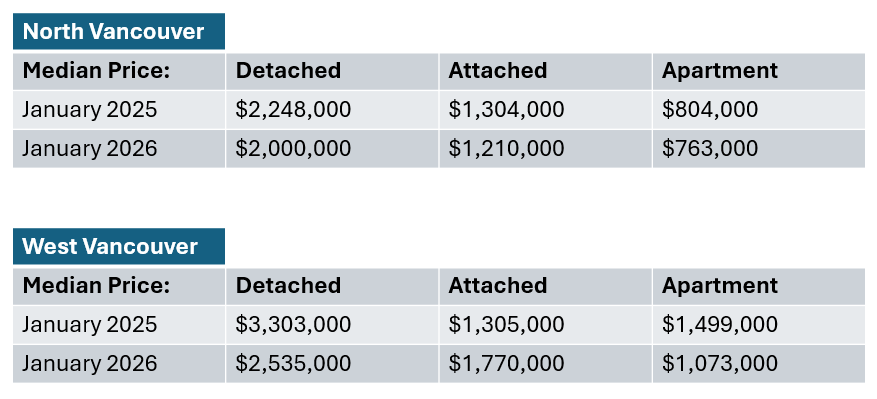
2025 Year-End Market Insights

Bottom Line

For many buyers, especially financially qualified ones, the North Shore is currently a favourable market to buy because:

  • Inventory is elevated and sales are below historical norms, creating buyer leverage.

  • Prices have softened or stabilized compared with recent highs.

  • Mortgage rates are more predictable and lower than in the past year.

  • Forecasts suggest modest market improvement ahead, so buying before broad demand re-emerges may be advantageous.

Read

Why the Next 60 Days Matter for Sellers

Historically, the first quarter of the year offers a unique window of opportunity for home sellers—and the data this year reinforces that pattern.

As shown in our current North and West Vancouver listing graph, the number of active residential listings at the start of January is materially lower than what we consistently see as we move toward spring and summer . This is not an anomaly. It is a seasonal trend that repeats itself year after year.

Less Competition Means More Attention

With fewer homes on the market right now, well-priced properties face less competition for buyer attention. Buyers who are active in January and February are typically motivated, informed, and prepared to act—often because they chose not to wait for the busier spring season.

Inventory Predictably Rises as Spring Approaches

The historical data clearly shows that listing counts climb steadily from late winter through early summer. As inventory rises, sellers are no longer competing with dozens of alternatives—they are competing with hundreds. More choice for buyers inevitably means longer decision cycles and increased pricing pressure.

Early Sellers Often Control the Narrative

Listing before the seasonal surge allows sellers to establish value without being influenced by a flood of comparable homes. In many cases, this translates to stronger showing activity and cleaner negotiations, simply because buyers have fewer substitutes.

The Takeaway

The next 60 days represent a strategic selling window:

  • Inventory is still low

  • Buyer demand is present

  • Competition will only increase from here

For homeowners considering a move this year, timing can be just as important as pricing and presentation. Acting before the spring inventory wave arrives can meaningfully improve positioning in the market.

Read
Categories:   #IMHOME CONTEST | Aluminum Wiring | Ambleside, West Vancouver Real Estate | Annual Pumpkin Patch | Bank of Canada | BC Assessment | BC Real Estate | Blueridge NV, North Vancouver Real Estate | Boulevard Real Estate | Buyers | Buying a Home | canuck place adventure challenge | Capilano NV, North Vancouver Real Estate | Central Coquitlam, Coquitlam Real Estate | Central Lonsdale, North Vancouver Real Estate | Coal Harbour, Vancouver West Real Estate | Common Property | conquer cancer lynn valley, ride to conquer cancer | Deep Cove, North Vancouver Real Estate | District of North Vancouver | Dollarton, North Vancouver Real Estate | Downtown VW, Vancouver West Real Estate | Dundarave, West Vancouver Real Estate | Energy Efficiency | False Creek North, Vancouver West Real Estate | Family Activities | First-Time Buyers | Forest Hills NV, North Vancouver Real Estate | Grouse Woods, North Vancouver Real Estate | Hamilton, North Vancouver Real Estate | Heat Pumps | Heritage Woods PM, Port Moody Real Estate | Home Buyer Programs | Home Inspections | Home Maintenance | Home Owner Grant | Home Staging | Home Values | Homeowners | Homeowners, | Housing Policy | Indian River, North Vancouver Real Estate | interest rates | Kids Activities | Lions Bay, West Vancouver Real Estate | live in lynn valley | Local Events | Lower Lonsdale, North Vancouver Real Estate | Lynn Valley, North Vancouver Real Estate | Lynnmour, North Vancouver Real Estate | Maintenance Fees | Market Updates | Metro Vancouver Real Estate | Mortgage Rates | Mortgage Renewal | Municipality | New Construction | North Shore Community | North Shore Living | North Shore Real Estate | North Vancouver | North Vancouver Events | North Vancouver Real Estate | North Vancouver Zoning | Northlands, North Vancouver Real Estate | Oil Tank Removal | permits | Preparing to Sell | Preparing to Sell, Home Staging | Pricing Strategy | Princess Park, North Vancouver Real Estate | Property Taxes | Property Values | pumpkin patch 2012 | Queensbury, North Vancouver Real Estate | R1 Zoning | R2 Zoning | Real Estate | Renfrew VE, Vancouver East Real Estate | Roche Point, North Vancouver Real Estate | Sellers | Selling a Home | Seniors | Spring Market | Strata | Strata Lot | Strata Property Act | Tempe, North Vancouver Real Estate | Unit Entitlement | Upper Lonsdale, North Vancouver Real Estate | Westlynn Terrace, North Vancouver Real Estate | Westlynn, North Vancouver Real Estate
Reciprocity Logo The data relating to real estate on this website comes in part from the MLS® Reciprocity program of either the Greater Vancouver REALTORS® (GVR), the Fraser Valley Real Estate Board (FVREB) or the Chilliwack and District Real Estate Board (CADREB). Real estate listings held by participating real estate firms are marked with the MLS® logo and detailed information about the listing includes the name of the listing agent. This representation is based in whole or part on data generated by either the GVR, the FVREB or the CADREB which assumes no responsibility for its accuracy. The materials contained on this page may not be reproduced without the express written consent of either the GVR, the FVREB or the CADREB.