RSS

Inspection vs. Appraisal: What’s the Difference?


Buying your first home comes with a lot of new terminology and it’s completely normal to feel unsure about what it all means. From inspections to appraisals, each step plays an important role in helping you make an informed decision. Here’s a simple breakdown of what these terms mean and why they matter when purchasing a home.

Home Inspection

Once you’re under contract on a home you’d like to buy, getting an inspection is a key part of the process. An inspection gives you a clear idea of the safety and overall condition of the home – which is important for such a big transaction. As a recent Realtor.com article explains:

“A home inspection is something that protects your financial interest in what will likely be the largest purchase you make in your life—one in which you need as much information as possible.”

If anything comes up during the inspection — such as the age of the roof, the condition of the heating system, or any other concerns — you may have the opportunity to discuss next steps with the seller before the purchase is final.

You won’t be navigating that conversation on your own. Your real estate agent will help you understand the findings, consider your options, and advocate for you throughout any further discussions or negotiations.

Home Appraisal

While the inspection tells you about the current state of the house, an appraisal gives you its value. Bankrate explains:

“When buying or selling a home, an appraisal verifies that the sale price of the home is in line with fair market value. This ensures the homebuyer doesn’t pay more than the home is worth, and the mortgage lender doesn’t lend more than it is worth.”

If you’re using a mortgage to purchase your home, the appraisal is an important step. It helps confirm the property’s value for the lender and offers an added layer of protection for you as the buyer.

If the appraised value comes in lower than the agreed purchase price, your real estate professional will help you understand your options and navigate any next steps, including possible negotiations.

Bottom Line

The inspection and appraisal are two different, but equally important, steps in the home buying process. The good news is, you don’t have to navigate them on your own. With the right guidance, you can move through each stage with clarity, confidence, and support from start to finish.

Read

What this means for buyers

More choice, less urgency
Inventory is up (well above the 10-year average), and sales are below normal levels. That gives buyers more options and time to make decisions—less of the pressure we saw in past spring markets.

Negotiation is back (in pockets)
With the sales-to-active listings ratio at 14.2%, we’re in balanced market territory—but leaning softer. Especially in apartments and attached homes, buyers have more leverage.

Detached may tighten
This is the interesting shift:

  • Detached sales up 8.3%

  • New listings down

That combination can create competition in select detached properties, even while the broader market feels calm.

Pricing isn’t falling fast—but it’s softer year-over-year
Prices are down ~6–8% from last year, but relatively stable month-to-month. Translation:

  • No sharp “deals” across the board

  • But better value than a year ago

Read

Buyers and sellers adopting a wait-and-see approach to housing market

Metro Vancouver home sales are moving at a pace similar to last year, dipping roughly three per cent compared to March 2025. According to Greater Vancouver REALTORS®, 2,032 homes sold in March 2026—2.8 per cent fewer than last year and well below the 10-year average of 2,981.

Big picture (what’s really going on)

  • Buyers are watching external factors (rates, global uncertainty)

  • Sellers are hesitating to list

  • The result: a steady but cautious market

Prices aren’t moving dramatically because:

  • Demand is softer

  • But supply isn’t flooding the market either

Simple summary

  • Buyers: more choice, some negotiating power, but act decisively on the right property

  • Sellers: homes are selling, but only with sharp pricing and strong presentation

  • Market tone: balanced, cautious, with early signs of strength in detached

With inventory up and demand steady, it’s a market that rewards preparation, patience and good advice.

Read

What “World Uncertainty” Actually Does to Real Estate

When there’s broader uncertainty—economic, political, interest rates, global events—it doesn’t eliminate demand. It recalibrates confidence.

On the ground, that shows up as:

· More cautious buyers
They take longer, analyze more and feel less urgency.

· Fewer impulsive decisions
The “I need to win this at any cost” mindset (2021–2022) fades.

· Greater price sensitivity
Buyers become more disciplined about value and comparables.

· Longer days on market
Not because homes aren’t desirable—but because decisions take longer.


Why the North Shore Still Holds Strong

The North Shore isn’t a speculative market—it’s a lifestyle-driven market.

People still want:

· Access to nature

· Strong schools

· Community feel

· Proximity to the city

That underlying demand doesn’t disappear. It pauses, reshapes and re-enters more thoughtfully.

So yes—homes are still selling every day. But they’re selling under different conditions:

· Well-priced homes → still move

· Well-presented homes → still attract attention

· Unique or scarce product → still performs strongest


The Post-COVID Hangover (2021–2022 Effect)

This is one of the biggest psychological factors right now.

That market was:

· Ultra-low rates

· Extremely limited inventory

· Emotion-driven bidding wars

· Speed over analysis

Today’s market is:

· Rate-aware

· Data-driven

· Choice-heavy (and growing)

· More balanced—or even buyer-leaning at times

The gap between expectation and reality is where friction lives.

Sellers remember peak pricing.
Buyers remember overpaying fears.
And both are trying to recalibrate.


What Actually Works in This Market

This is where your philosophy is spot on—and worth reinforcing:

A successful transaction today comes down to alignment:

· Timing: Does the move make sense for your life?

· Financial comfort: Can you carry it confidently?

· Product quality: Is the home desirable in today’s lens?

· Strategy: Is pricing and presentation grounded in today’s market—not yesterday’s?

When those line up, the market becomes far less intimidating.


The Long-Term Lens

Real estate—especially on the North Shore—is not a short-term trade.

If someone is:

· Buying and holding

· Making a lifestyle move

· Improving their day-to-day living

· Stepping into the right property for their needs

Then short-term market fluctuations matter far less.

Uncertainty creates hesitation—but it also creates opportunity for thoughtful decisions.


Bottom Line:

People still want to live on the North Shore—and that hasn’t changed. What has changed is how they’re making decisions.

We’ve moved from a fast, emotional market to a more thoughtful, measured one. Homes are still selling every day—but pricing, presentation and timing matter more than ever.

If a move makes sense for your life, your goals and your finances—and you’re focused on the long term—it’s still a very good time to buy or sell. The strategy just needs to match the moment.

Read

A Meaningful Shift for First-Time Buyers

Announced last Spring, the federal First-Time Home Buyers' (FTHB) GST/HST Rebate is now in effect as of March 2026, offering up to $50,000 in tax relief on new or substantially renovated homes, says the Canada Revenue Agency (CRA). Eligible buyers can receive a full rebate on homes under $1 million and a partial rebate on homes up to $1.5 million, provided the purchase agreement was signed on or after March 20, 2025. The Canada Revenue Agency will now be able to start processing rebate claims.

Please note that the rebate will generally apply to agreements of purchase and sale entered on or after March 20, 2025 and before 2031.

What this means for first-time home buyers:

In simple terms, this rebate can reduce the upfront cost of buying a new home—sometimes by a meaningful amount.

  • Less tax to pay:
    Buyers may receive up to $50,000 back, lowering the total purchase cost of a new or substantially renovated home.

  • Improved affordability:
    With less cash needed for GST/HST, buyers may find it easier to qualify for a mortgage or stay within budget.

  • More options to consider:
    New construction and pre-sale homes—which often felt out of reach—may now be more realistic choices.


What it doesn’t change:

  • It only applies to new or substantially renovated homes (not most resale properties)

  • Eligibility will depend on price thresholds and buyer qualifications

  • It doesn’t replace the need to be well-priced and strategic in today’s market


The takeaway:

For first-time buyers, this is one of the more tangible shifts we’ve seen—it can meaningfully reduce the cost of getting into the market, particularly if you’re open to newer homes.

If you know someone that were first time buyers and purchased a new home for under $1.5million between March 20 2025 and today, you should reach out and make sure they apply for the rebate.

Read

“Rates Held—Here’s What It Really Means for You”

Yesterday’s Bank of Canada hold means variable rates stay put, while fixed rates will continue to move based on bond yields and inflation expectations—not the Bank’s decision itself.

Here’s a reminder of how these decisions affect fixed & variable interest rates:


🔹 1. Variable rates — “direct connection”

Think of this like a light switch.

  • The Bank of Canada sets a key rate

  • Banks use that to set prime rate

  • Variable mortgages = Prime ± something

👉 So:

  • If the Bank raises → variable rates go up

  • If the Bank cuts → variable rates go down

  • If the Bank holds → variable rates stay basically the same

✔️ That’s why today:
👉 No change = no real change to variable rates (Canadian Mortgage Services)


🔹 2. Fixed rates — “market-driven”

Fixed rates are NOT set by the Bank of Canada directly

Instead, they follow bond yields (especially 5-year bonds)

And bond yields are driven by:

  • Inflation expectations

  • Economic outlook

  • Global events (oil, wars, U.S. economy, etc.)

👉 So fixed rates are more like a stock price — always moving

✔️ Even if the Bank does nothing:

  • Fixed rates can go up or down anyway

  • Because markets are constantly reacting

(Example: rising oil prices today are creating inflation concerns, which can push bond yields—and fixed rates—around) (Reuters)


🔹 Simple analogy:

  • Variable rate = tied to the Bank (like a thermostat you control)

  • Fixed rate = tied to the market (like the weather outside)


🔹 What today’s “hold” really means

  • ✅ Variable-rate clients: steady / no change

  • ⚠️ Fixed-rate clients: still watching inflation + bond market


The takeaway…
Even without a rate change, borrowing costs can still move—so timing and strategy still matter.

Read

Don’t Let Headlines Decide Your Real Estate Decisions

If you’ve glanced at the news lately, you’ve likely seen a wave of unsettling real estate headlines—stories about market “malaise,” pressure on buyers, declining sales, and even predictions of a looming crash. In a single day, it’s not unusual to see multiple headlines painting a discouraging picture.

But here’s the reality: headlines are designed to grab attention—not to guide your personal decisions.

The media thrives on extremes. Negative narratives create urgency and fear, and in doing so, they often amplify noise rather than provide meaningful clarity. What gets lost in the process is context—your context.

Yes, the market has shifted. We’ve moved from the frenzied “fear of missing out” we saw during the height of the pandemic—when inventory was scarce and competition fierce—to a more cautious, thoughtful mindset. Buyers today are focused on making the right move at the right time.

And that makes sense.

Inventory levels have risen. The cost of living remains high. Inflation and global uncertainty are part of everyday conversation. According to a recent RBC poll, more than half of British Columbians are consistently thinking about whether they can afford a home. Yet despite these concerns, the desire for homeownership remains strong—because owning a home still represents stability, pride, and long-term security.

So what does all of this mean?

It means the “right time” to buy or sell has very little to do with headlines—and everything to do with your goals.

In fact, today’s market conditions can be quite favourable for buyers in certain segments. For example, the North Vancouver apartment market is currently offering more choice and less competition than we’ve seen in years. For someone with a long-term outlook, this could present a meaningful opportunity.

At the same time, even a “perfect” market doesn’t make it the right moment if it doesn’t align with your personal circumstances.

That’s the key: real estate is not one-size-fits-all.

Your timing depends on your life, your finances, your plans, and your comfort level—not on a national headline or a generalized market prediction.

So rather than getting caught up in the noise, take a step back and ask yourself:

  • What am I trying to achieve?

  • What does the next chapter look like for me?

  • How does real estate support that vision?

From there, the conversation becomes much clearer.

If you’re curious about what’s actually happening in our local market—and how it aligns with your goals—it’s worth having a conversation with a trusted real estate professional. Not to react to fear, but to make informed, confident decisions.

Because in the end, the best real estate decisions aren’t driven by headlines.

They’re driven by you.

Read

Our Spring Market Has Begun — What You Should Know

While the calendar may still say winter, the North Vancouver real estate market is already showing early signs of spring activity. Each year, momentum tends to build quietly before the traditional March-to-May peak — and that shift is now underway.


For Sellers

Buyers are out there — and they’re prepared.
Serious purchasers have started their search earlier this year, watching closely for new listings. Well-prepared homes that come to market now are seeing strong early interest, particularly when priced in line with current conditions.

Competition is growing.
Inventory is beginning to rise, which means sellers entering the market this spring will be competing with more choice than we’ve seen in recent years. Strategic pricing and thoughtful presentation will make all the difference.

Timing can be advantageous.
Listing at the start of the spring cycle can allow your home to stand out before the market becomes more crowded later in the season.


For Buyers

More options are arriving.
As new listings come online, buyers will see greater selection across property types and price ranges. This is often when opportunities appear that weren’t available earlier in the year.

A calmer pace allows for thoughtful decisions.
While desirable homes can still attract strong interest, the overall environment feels more balanced, giving buyers time to evaluate choices carefully.

Preparation remains key.
The most successful buyers are those who are ready to act when the right property appears — particularly for homes that are well-located, well-maintained, and priced appropriately.


OUR PERSPECTIVE

The early spring market often sets the tone for the months ahead. Whether you’re considering selling, buying, or simply staying informed, this is an important moment to understand how the landscape is evolving.

If a move is on your horizon for 2026, even if it’s not immediate, we’re always happy to provide guidance so you can plan with clarity and confidence.

Read

Should I be paying attention, or can I ignore real estate until spring?

Many people ask this question at the start of the year — especially after the last few years of noisy headlines and fast-moving markets.

The short answer?

You don’t need to make any decisions today — but this is a good time to start paying attention.

Right now, there’s breathing room again. Thoughtful decisions are back in style. The pace feels calmer, more deliberate, and far less reactive than what we’ve seen in recent years.

On the ground, what we’re noticing is more intelligent pricing. Sellers are, by and large, pricing homes more accurately from the start, rather than “testing” the market and chasing it down later. That shift alone makes the landscape easier to navigate — whether you’re buying, selling, or simply observing.

What we’re watching closely as we move toward spring is inventory growth and sales activity. These two indicators tend to quietly shape the months ahead, long before the broader headlines catch up. Understanding how supply and demand are unfolding locally can provide valuable context — even if you’re not planning to move anytime soon.

And that’s an important point.

Even if you’re not moving this year, staying aware of what’s happening in the market still matters. Knowing how your home fits into the bigger picture — how equity is shifting, how timing affects options, and what flexibility you may have down the road — can be thought of as a form of financial self-care. It’s not about pressure or urgency; it’s about being informed.

If you are pondering a move this year, consider this your permission to simply observe for now. You don’t need to decide today. But paying attention early often leads to better, more confident decisions later.

And if you ever want to talk things through — whether it’s a specific plan or just a “where do things stand?” conversation — we are always happy to be a sounding board.

Read

Is it a Good Time to Buy?

Posted 5-year Mortgage Rates:

January 2025: 6.79%
January 2026: 4.56%

Savings per $100K per month: $130.69

2025 Year-End Market Insights

Bottom Line

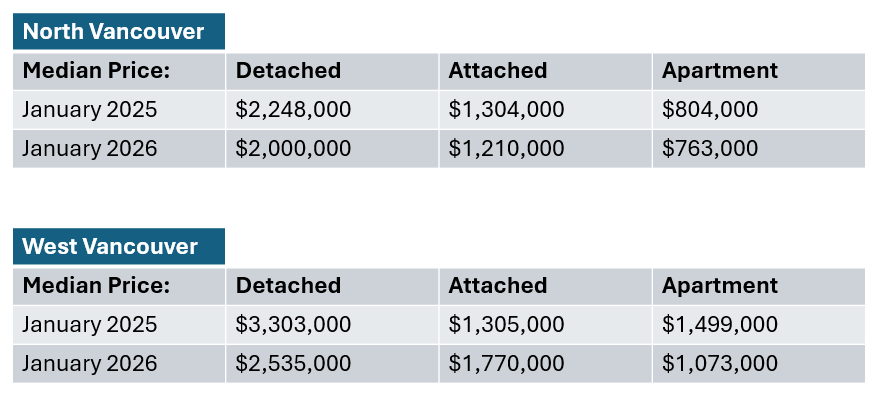
For many buyers, especially financially qualified ones, the North Shore is currently a favourable market to buy because:

  • Inventory is elevated and sales are below historical norms, creating buyer leverage.

  • Prices have softened or stabilized compared with recent highs.

  • Mortgage rates are more predictable and lower than in the past year.

  • Forecasts suggest modest market improvement ahead, so buying before broad demand re-emerges may be advantageous.

Read
Categories:   #IMHOME CONTEST | Aluminum Wiring | Ambleside, West Vancouver Real Estate | Annual Pumpkin Patch | Bank of Canada | BC Assessment | BC Real Estate | Blueridge NV, North Vancouver Real Estate | Boulevard Real Estate | Buyers | Buying a Home | canuck place adventure challenge | Capilano NV, North Vancouver Real Estate | Central Coquitlam, Coquitlam Real Estate | Central Lonsdale, North Vancouver Real Estate | City of North Vancouver | Coal Harbour, Vancouver West Real Estate | Common Property | Condo | conquer cancer lynn valley, ride to conquer cancer | Deep Cove, North Vancouver Real Estate | District of North Vancouver | Dollarton, North Vancouver Real Estate | Downtown VW, Vancouver West Real Estate | Dundarave, West Vancouver Real Estate | Energy Efficiency | False Creek North, Vancouver West Real Estate | Family Activities | First-Time Buyers | Forest Hills NV, North Vancouver Real Estate | Grouse Woods, North Vancouver Real Estate | Hamilton, North Vancouver Real Estate | Heat Pumps | Heritage Woods PM, Port Moody Real Estate | Home Buyer Programs | Home Inspections | Home Insurance | Home Maintenance | Home Owner Grant | Home Staging | Home Values | Homeowners | Homeowners, | Housing Policy | Indian River, North Vancouver Real Estate | interest rates | Investment Property | Kids Activities | Lions Bay, West Vancouver Real Estate | live in lynn valley | Local Events | Lower Lonsdale, North Vancouver Real Estate | Lynn Valley, North Vancouver Real Estate | Lynnmour, North Vancouver Real Estate | Maintenance Fees | Market Updates | Metro Vancouver Real Estate | Mortgage Rates | Mortgage Renewal | Multi Generational Living | Municipality | New Construction | North Shore Community | North Shore Living | North Shore Real Estate | North Vancouver | North Vancouver Events | North Vancouver Real Estate | North Vancouver Zoning | Northlands, North Vancouver Real Estate | Oil Tank Removal | permits | Preparing to Sell | Preparing to Sell, Home Staging | Pricing Strategy | Princess Park, North Vancouver Real Estate | Property Taxes | Property Values | pumpkin patch 2012 | Queensbury, North Vancouver Real Estate | R1 Zoning | R2 Zoning | Real Estate | Renfrew VE, Vancouver East Real Estate | Rental Income | Roche Point, North Vancouver Real Estate | Sellers | Selling a Home | Seniors | Spring Market | Strata | Strata Lot | Strata Property Act | Tempe, North Vancouver Real Estate | Unit Entitlement | Upper Lonsdale, North Vancouver Real Estate | Westlynn Terrace, North Vancouver Real Estate | Westlynn, North Vancouver Real Estate
Reciprocity Logo The data relating to real estate on this website comes in part from the MLS® Reciprocity program of either the Greater Vancouver REALTORS® (GVR), the Fraser Valley Real Estate Board (FVREB) or the Chilliwack and District Real Estate Board (CADREB). Real estate listings held by participating real estate firms are marked with the MLS® logo and detailed information about the listing includes the name of the listing agent. This representation is based in whole or part on data generated by either the GVR, the FVREB or the CADREB which assumes no responsibility for its accuracy. The materials contained on this page may not be reproduced without the express written consent of either the GVR, the FVREB or the CADREB.