RSS

Should I be paying attention, or can I ignore real estate until spring?

Many people ask this question at the start of the year — especially after the last few years of noisy headlines and fast-moving markets.

The short answer?

You don’t need to make any decisions today — but this is a good time to start paying attention.

Right now, there’s breathing room again. Thoughtful decisions are back in style. The pace feels calmer, more deliberate, and far less reactive than what we’ve seen in recent years.

On the ground, what we’re noticing is more intelligent pricing. Sellers are, by and large, pricing homes more accurately from the start, rather than “testing” the market and chasing it down later. That shift alone makes the landscape easier to navigate — whether you’re buying, selling, or simply observing.

What we’re watching closely as we move toward spring is inventory growth and sales activity. These two indicators tend to quietly shape the months ahead, long before the broader headlines catch up. Understanding how supply and demand are unfolding locally can provide valuable context — even if you’re not planning to move anytime soon.

And that’s an important point.

Even if you’re not moving this year, staying aware of what’s happening in the market still matters. Knowing how your home fits into the bigger picture — how equity is shifting, how timing affects options, and what flexibility you may have down the road — can be thought of as a form of financial self-care. It’s not about pressure or urgency; it’s about being informed.

If you are pondering a move this year, consider this your permission to simply observe for now. You don’t need to decide today. But paying attention early often leads to better, more confident decisions later.

And if you ever want to talk things through — whether it’s a specific plan or just a “where do things stand?” conversation — we are always happy to be a sounding board.

Read

Is it a Good Time to Buy?

Posted 5-year Mortgage Rates:

January 2025: 6.79%
January 2026: 4.56%

Savings per $100K per month: $130.69

2025 Year-End Market Insights

Bottom Line

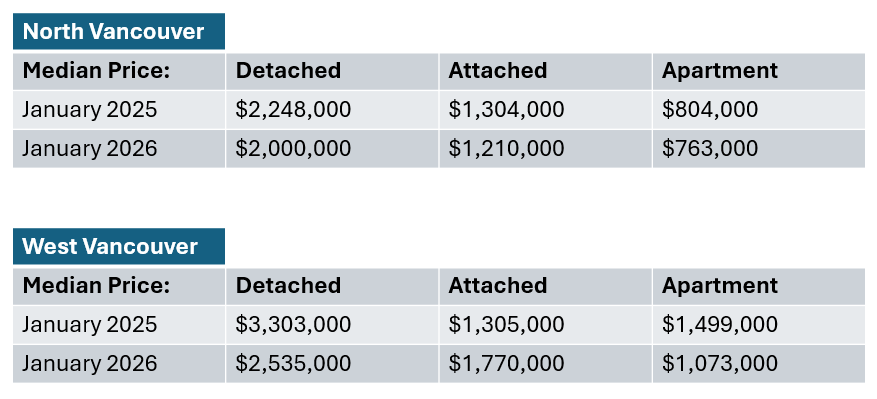
For many buyers, especially financially qualified ones, the North Shore is currently a favourable market to buy because:

  • Inventory is elevated and sales are below historical norms, creating buyer leverage.

  • Prices have softened or stabilized compared with recent highs.

  • Mortgage rates are more predictable and lower than in the past year.

  • Forecasts suggest modest market improvement ahead, so buying before broad demand re-emerges may be advantageous.

Read

Why the Next 60 Days Matter for Sellers

Historically, the first quarter of the year offers a unique window of opportunity for home sellers—and the data this year reinforces that pattern.

As shown in our current North and West Vancouver listing graph, the number of active residential listings at the start of January is materially lower than what we consistently see as we move toward spring and summer . This is not an anomaly. It is a seasonal trend that repeats itself year after year.

Less Competition Means More Attention

With fewer homes on the market right now, well-priced properties face less competition for buyer attention. Buyers who are active in January and February are typically motivated, informed, and prepared to act—often because they chose not to wait for the busier spring season.

Inventory Predictably Rises as Spring Approaches

The historical data clearly shows that listing counts climb steadily from late winter through early summer. As inventory rises, sellers are no longer competing with dozens of alternatives—they are competing with hundreds. More choice for buyers inevitably means longer decision cycles and increased pricing pressure.

Early Sellers Often Control the Narrative

Listing before the seasonal surge allows sellers to establish value without being influenced by a flood of comparable homes. In many cases, this translates to stronger showing activity and cleaner negotiations, simply because buyers have fewer substitutes.

The Takeaway

The next 60 days represent a strategic selling window:

  • Inventory is still low

  • Buyer demand is present

  • Competition will only increase from here

For homeowners considering a move this year, timing can be just as important as pricing and presentation. Acting before the spring inventory wave arrives can meaningfully improve positioning in the market.

Read

Understanding Your Property Assessment — And What It Means in 2026

Each January, homeowners across British Columbia receive their annual property assessment, and with it often comes confusion. Many people wonder: Is this what my home is really worth? The short answer is — not necessarily.

Assessed Value vs. Market Value

In British Columbia, property assessments are prepared by BC Assessment and reflect market value as of July 1 of the preceding year. That timing is critical.

A REALTOR®’s opinion of value reflects today’s market conditions, while your assessment is based on a snapshot from roughly six months earlier. In changing markets, this timing gap can create noticeable differences between assessed value and current market value.

Why Assessed Values and Market Values Differ

There are two main reasons:

1. Mass appraisal methodology
BC Assessment uses a mass appraisal system. Values are derived primarily from MLS® sales data within neighbourhoods or strata complexes, rather than individual property inspections. This broad approach is effective for taxation purposes but does not account for unique features, renovations, condition, or micro-market influences.

2. Time lag
Your 2026 assessment reflects estimated market value as of July 1, 2025 — not today. When markets shift, assessed values may lag behind real-time pricing.

What Assessments Are Really For

Market-value assessment is widely considered the fairest way to distribute the property tax burden across homeowners. However, it is important to understand that assessed value is not designed to be a precise indicator of what your home would sell for today.

Key Definitions

  • Market Value:
    The price expected if a reasonable amount of time is allowed to find a purchaser, and both buyer and seller are fully informed.

  • Assessed Value:
    The most probable price an unencumbered property would have sold for on the open market as of July 1 of the preceding year.

What’s Happening With 2026 Assessments

According to BC Assessment, the cooling housing market is now being reflected in 2026 values. Many homeowners across the Lower Mainland are seeing assessed value decreases ranging from 0% to approximately 10%, based on July 1, 2025 valuations.

In response to these changes, the British Columbia Ministry of Finance has also adjusted the B.C. Homeowner Grant threshold for the first time in six years. For 2026, the threshold has been reduced to $2.075 million, down from $2.175 million last year, aligning with lower assessed values across Metro Vancouver.

Why This Matters to You

A lower assessed value does not automatically mean lower property taxes, as taxes are determined by municipal budgets and tax rates. However, assessments do affect eligibility for programs such as the homeowner grant and provide insight into broader market trends.

If you are considering selling, refinancing, or simply want to understand your home’s current value, an assessment should be viewed as one data point — not the full picture.

As always, we are happy to provide a current market evaluation and context specific to your property and neighbourhood.

Read

Three Basic Pricing Strategies for Sellers in a Buyers’ Market

When conditions shift in favour of buyers—more supply, longer days on market, and increased negotiation leverage—pricing discipline becomes the seller’s most important tool. Here are the three foundational strategies, along with the key considerations for each.

1. Market-Matching Pricing (Price at or just below the most recent comparables)

What it is:
Setting the asking price directly in line with the most recent and relevant sales, or marginally below them, to ensure the home ranks as a “best value” option in the active inventory.

When to use it:

  • Inventory is high and competitive.

  • Nearby comparables have sold recently at clearly defined price points.

  • The goal is predictable, steady buyer engagement without a prolonged marketing period.

Things to be aware of:

  • Buyers in a soft market are extremely price-sensitive; even being slightly above the pack can result in no showings.

  • This strategy avoids overpricing risk but does not typically generate bidding pressure—expect more linear negotiations.


2. Value-Leader Pricing (Price below market to create momentum and competition)

What it is:
Intentionally positioning the property below the anticipated sale price to drive traffic, urgency, and in some cases, multiple offers—even in a buyers’ market.

When to use it:

  • The home is highly desirable (best layout, updated, private, great light, strong location).

  • Neighbourhood inventory is stale, and a standout listing can capture concentrated attention.

  • Sellers are motivated to sell within a defined timeframe.

Things to be aware of:

  • This is not “discounting”—it is a strategy to shift the psychology of the market from slow to active.

  • It requires confidence in the product. If the home has major deferred maintenance, the strategy may simply anchor buyer expectations lower.

  • Timing, marketing, and presentation must be flawless to capitalize on the momentum this strategy creates.


3. Aspirational Pricing (Price above market while watching inventory and feedback closely)

What it is:
Setting a slightly higher price to test the upper boundary of the market, usually with flexible expectations and planned checkpoints for adjustment.

When to use it:

  • The seller is not time-sensitive.

  • The home offers uncommon features, but the value of those features is hard to quantify with comps alone.

  • There is very little direct competition.

Things to be aware of:

  • Overpricing is far more damaging in a buyers’ market than in a balanced or sellers’ market.

  • Traffic drops quickly when buyers perceive a price as unrealistic; they don’t test high prices with low offers—they simply skip the home.

  • The longer the property sits, the steeper the eventual discount tends to be.

  • A predetermined adjustment timeline (e.g., 14–21 days with little activity) is critical to protect momentum.


Key Realities Sellers Should Understand

Regardless of the strategy chosen, sellers in a buyers’ market should be aware of:

1. Momentum is everything

A new listing gets its highest visibility in the first 10–14 days. Pricing must support that window of opportunity.

2. Buyers judge quickly and harshly in soft markets

If the price feels unbelievable, buyers lean away—silently. They don’t send feedback; they simply move on.

3. Stale days on market carry an emotional cost

Each additional day increases the likelihood of deeper negotiations and lower offers.

4. Presentation and condition matter more

With more choice, buyers gravitate to the best-looking, best-priced homes. Deferred maintenance becomes more expensive to the seller in a buyers’ market.

5. Adjustments are a strategy, not a failure

Market-responsive pricing changes keep a listing relevant and protect the seller’s final outcome.

Read

Greater Vancouver market in a kind of “pause mode” ?

✅ Evidence in favor of a “pause / in-transition” market now

  • Sales remain significantly below long-term norms. The October 2025 report from GVR shows 2,255 residential sales — 14.3% fewer than October 2024, and some 14.5% below the 10-year seasonal average.

  • Inventory remains elevated. As of October 2025, there were 16,393 active listings — up 13.2% from a year ago and well above the 10-year seasonal average of about 12,063.

  • Sales-to-active-listings ratio is low (especially for certain segments). In October 2025, the ratio was 11.3% for detached homes — below the ~12% threshold typically associated with downward price pressure.

  • Benchmark prices — especially for detached homes and apartments — are pressured or slipping. October 2025 saw decreases in benchmark prices for detached homes, condos, and townhouses (compared with the prior year).

  • Province-wide outlook expects modest growth, not a boom. According to BCREA’s “2025 Fourth Quarter Housing Forecast,” the average price in BC is expected to rise only ~4% in 2026, with the market described as “balanced,” driven partly by a rebound in higher-cost Lower Mainland markets.

  • Overall, residential sales across BC remain sluggish. BCREA reported a decline in total MLS® residential sales in October 2025, down about 10.2% compared with October 2024.

All of this suggests that demand is out of sync with supply at the moment — more choices than buyers, especially among certain segments, which naturally slows things down. For a buyer, that’s likely good news (more selection, less competition). For a seller, it means a more tempered — and cautious — market.

🔄 Signs the Market Might “Restart” or Shift Toward Balance by 2026

That said — calling it a full “freeze” would be misleading. There are reasons to believe 2026 could bring renewed momentum, which makes “pause” a helpful — but temporary — descriptor.

  • According to BCREA’s forecast, 2026 is expected to bring a rebound: they forecast a rise in MLS® sales (and a mild uptick in prices), as markets across BC — including the Lower Mainland — regain some momentum.

  • Some segments may already be stabilizing: GVR’s June 2025 data saw sales down ~9.8% year-over-year, but the year-over-year decline was roughly half of the prior month’s drop — a sign that the downward spiral might be bottoming out.

  • The broader public commentary and market-commentary (from local brokerages, economists) suggest that what we’re seeing is “normalization” — not collapse. Many analysts expect 2025–2026 to return more to “long-term norms” rather than the extremes seen in boom years.

So — while things are slow now, the pieces are in place for a rebound or at least a market stabilization by mid-2026, rather than a prolonged slump.

📍 What “Pause Until 2026” Means — and What It Doesn’t

When we say “pause until 2026,” we mean:

  • A balanced or buyer-favoured environment — not a market crash, but a calmer, more measured pace than the frenzy of 2021–2022.

  • Selective activity — certain segments / property types (price range, neighbourhood, property style) will outperform others; what moves may depend on pricing, condition, and marketing finesse.

  • Opportunities for both buyers and sellers — buyers get more choice and negotiating power; sellers who price well & market smart may still do well, though timing and positioning matter more than ever.

  • Less volatility overall — price swings likely to be muted compared with the past few years.

But that doesn’t mean:

  • No deals — there will still be sales; some properties will draw interest, especially well-positioned ones, and motivated buyers will still act.

  • Uniformity across Greater Vancouver — local variances (by municipality, neighbourhood, property type) will drive different results; North Vancouver may not behave exactly like Surrey or downtown Vancouver.

  • Guaranteed rebound by 2026 — forecasts always carry uncertainty; economic conditions, interest rates, immigration, and other macro factors could shift the trajectory.

We think that “pause until 2026” is more or less what the data reflect now, especially for Metro-Greater Vancouver broadly. But I’d phrase it not as “a freeze,” but as “a market resetting toward equilibrium,” with potential upside if macro conditions align (rates, economy, immigration, buyer confidence, etc.).

Read

Five Electrical Issues for which an Electrician can be Needed

A lot can go wrong in a home that can be costly to repair – it can also often be dangerous. In the case of electrical issues, they can range in severity from the inconvenience of power disruption to the threat of fire or electric shock. There are several common electrical issues that you can be aware of so you’ll feel more at ease if they come up during showings or even after a purchase.

 Electrical experts find and fix issues before they become hazards

 In many cases, common signs could point toward multiple potential problems. This is why an expert is often required to pinpoint and fix any issues so the home and its occupants always remain safe and the electrical system runs properly.

In addition to being able to identify common electrical issues and their causes, it’s wise for all homeowners to have a trusted electrician to call when they sense something isn’t quite right. It’s always helpful to have a list of local experts on hand so you can help make future repairs easier for your buyers.

 Five electrical issues for which an electrician may be needed


1. Sparking from an outlet or a loose, discolored outlet. This could indicate faulty wiring and should be addressed immediately to prevent fire.

2. Flickering lights. Try changing the lightbulb and ensuring it’s fully screwed into the fixture. If this doesn’t fix the problem, flickering may indicate an overloaded circuit, a loose connection, the wrong type of lightbulb being used, faulty switches or voltage changes.

3. Rodents present in the house. Rodents love to chew – and their snack of choice is often electrical wiring. They also enjoy nesting around junction boxes. Be sure to check these areas once you discover rodents in the home. Faulty wiring caused by rodents will often produce flickering lights as well, so also check these areas if changing the lightbulb doesn’t solve point number two above.

4. Short circuits. Outdated or improperly installed wiring can become a hidden danger, lurking behind walls and ceilings. Over time, wear and tear can compromise the integrity of the wiring, leading to short circuits and potential fire hazards.

5. Overloaded circuits. In a time where our lives revolve around electronic gadgets, it’s tempting to plug in multiple devices to a single power strip. But, overloading circuits is a common issue that can lead to tripped breakers and, in more severe cases, electrical fires. Understanding the capacity of the electrical circuits and avoiding excessive use of power strips is essential. Distributing electrical loads evenly across different circuits and considering an upgrade if needed can prevent overloads and enhance the home’s overall safety.

The importance of maintaining a home’s electrical system is one key area that an annual home maintenance inspection addresses. The home inspector will be looking for these electrical issues and more. This is also a great time for your clients to bring up any issues they’ve noticed throughout the year that weren’t remedied right away.

Preventative maintenance not only offers homeowners peace of mind, but it can also point to areas that, if addressed sooner rather than later, can actually help save them money. Regular inspections, timely repairs and upgrades when necessary are crucial steps in maintaining a secure and reliable electrical infrastructure.

By addressing these top five electrical issues, homeowners can worry less knowing that their living space is safeguarded against power disruptions and potential electrical hazards.

Read

Pre-Approval Isn’t Commitment – it’s Clarity

If buying a home is on your radar – even if it’s more of a someday plan than a right now plan – getting pre-approved early is still one of the smartest moves you can make. Why? Because, like anything in life, the right prep work makes things clearer.

The best time to get serious about buying is before you’re ready to buy. Here’s why.

Pre-Approval Helps You Understand Your Numbers

One of the biggest benefits of pre-approval is how it helps you understand your buying power. As part of the pre-approval process, a lender will walk through your finances and tell you what you can borrow based on your income, debts, credit score, and more. That number is power.

Once you have that clarity, you’re no longer guessing. You know what you’re working with. And that gives you the information you need to be able to plan ahead. That way, you’re not falling in love with homes that are outside of your price range – or missing out on ones that aren’t.

Pre-Approval Helps You Move Quickly When You’re Ready

You don’t have to be ready to buy to be ready to buy.

It happens all the time – someone scrolls through listings just for fun, and then BAM – they fall in love with something they see online. But by the time they scramble to connect with an agent and then get pre-approved with a lender, someone else beats them to it, and they lose the home. And you don’t want that to happen to you.

While you can’t control when the right home shows up – you can be ready for it.

Pre-approval isn’t about jumping the gun or rushing your timeline. It’s about making sure you’re ready when it’s go-time. As Experian explains:

“Waiting too long to get a preapproval, however, could leave you at a disadvantage . . . you could find the perfect home, but another buyer could snatch it up while you’re waiting for the lender to review your preapproval application. . . getting a preapproval just before you begin actively looking at homes may be your best option.”

Instead of rushing to figure out your numbers, trying to get documentation for your home loan together, and watching the house you love slip away while you wait to hear from your lender, you’re already in the game.

It’s like showing up to the starting line with your shoes tied and your warm-up done – while everyone else is still looking for parking.

But pre-approvals do have an expiration date, so be sure to ask your lender how long it’s good for. Bankrate offers this insight:

“Many mortgage preapprovals are valid for 90 days, though some lenders will only authorize a 30- or 60-day preapproval. If your preapproval expires, getting it renewed can be as simple as your lender rechecking your credit and finances to ensure there have been no major changes to your situation since the first time ‘round.”

The thing is, if you’ve been pre-approved – even if you’re just thinking about casually looking – you have a much better sense of how to navigate your home search within your budget. Plus, you’ll be ready if the perfect home comes along. So why not make it happen?

Bottom Line

Getting pre-approved doesn’t mean you have to buy a house today. But it does mean you’ll know what you're working with when the right one shows up. If you want to get pre-approved, connect with a lender to get that process started.

In the meantime, have a conversation with an agent about what's on your mind and what you're looking for.

If the perfect house popped up tomorrow, would you be ready to make a move?

Read

2024 - What a ride

The Metro Vancouver real estate market wrapped up 2024 on a high note, with renewed energy and plenty of buyer activity. Here’s a quick and friendly look at the key trends that shaped the market:

Sales Performance

December 2024 saw 1,765 homes sold—that’s a 31.2% jump from December 2023! While still 14.9% below the 10-year average, this uptick shows growing interest as we head into 2025.

For the whole year, total sales hit 26,561, a slight 1.2% rise from 2023. Even though sales are 20.9% below the decade average, December’s momentum hints at better times ahead.

Price Stability

The benchmark price for all homes in Metro Vancouver was $1,171,500 in December. That’s a 0.5% increase from December 2023 and just a tiny 0.1% drop from November 2024. Detached homes saw a 2% price bump over the year, townhouses were up 3.4%, and apartment prices stayed steady.

Active Listings and Inventory

There were 10,948 homes listed for sale in December, a 24.4% boost from last year and 25.3% above the 10-year average. This gives buyers more choices as the market finds its balance.

Sales-to-Active Listings Ratios

The sales-to-active listings ratio for December 2024 was 16.8% overall. Here’s how it breaks down:

  • Detached homes: 12.1%

  • Townhouses: 23.6%

  • Apartments: 18.7%

When the ratio dips below 12%, prices tend to drop, and when it’s over 20%, prices usually rise.

Looking Ahead

With borrowing costs dropping and buyer confidence growing, 2025 is shaping up to be a lively year for real estate. December’s strong performance suggests more sales and potential price growth in the coming months.

Thinking about buying or selling in 2025? Now’s a great time to start planning and take advantage of the improving market. Stay tuned for more updates and tips to help you navigate the exciting opportunities ahead!

Read

Home Staging FAQ: What You Need To Know

You may have heard that staging your home properly can make a big difference when you sell your house, but what exactly is home staging, and is it worth your time and effort?

Here are a few quick FAQs that can help you decide how much you should prioritize staging as you prep for your move.

What Is Home Staging?
Staging is the process of arranging and decorating your house to highlight its best features and make it as appealing as possible to potential buyers. It can range from simple touch-ups to more extensive setups, depending on your needs and budget.

How Does It Help Me Sell My House?
Studies show good staging does have an impact on your sale. Staging your house well can help you attract more attention from buyers, which ultimately helps it sell faster and maybe for a higher price than an unstaged home (see visual):

What Are My Staging Options?
Now that you see the value, let’s think through your options. The most common is leaning on your agent for their expert advice. They know what buyers like because they’re in showings all the time and hear that feedback first-hand. That expertise is crucial to getting your house market-ready. Basic staging with an agent usually means they give you insight into how you should:

  • Declutter and depersonalize by removing photos and personal items

  • Arrange your furniture to improve the room’s flow and make it feel bigger

  • Add plants, move art, or re-arrange other accessories

Full-service staging is another option if your house needs more hands-on attention. This is when you hire a staging professional or staging company to come in, make recommendations, and do the work for you. Going this route is more involved and that makes it more costly too. That’s because it can include renting furniture and decor to more fully transform a space.

How Do I Know Which One To Pick?
Not sure which one you need? You don’t have to figure that out on your own. Your real estate agent will help determine what level of staging will make the most impact on your house and market.

They can help you decide if professional staging is worth the investment, or if you can knock it out with their advice alone. And just so you know, here are some of the factors an agent will look at to figure that out:

Market Conditions: If the market is slower, going all in on staging can make your home look move-in ready and attractive to buyers who may otherwise be hesitant. If your local market is very active and homes are selling fast, you may be able to get by with doing less.

Your Home’s Condition: If your home is vacant or has a unique layout, using a professional stager who can bring in the right furniture and accessories may help buyers truly visualize its full potential.

Your Budget: Talk to your agent to get an idea of staging costs in your area, as it can be the difference between your house selling and sitting. But if your budget is tight or your home only needs minor updates, your real estate agent can help you think outside of the box by suggesting simple DIY staging tips to help your home look its best.

Bottom Line
Staging your house properly can make it much more attractive to buyers, but it’s not a one-size-fits-all solution, and every home shines differently. If you’re considering staging, talk to your real estate agent—they’re your best resource for determining what your home really needs to stand out and sell for top dollar.

Read

The lowest rate isn't always the best rate: Here's why

When shopping for a mortgage, it’s easy to get drawn in by the lowest advertised rate. After all, who doesn’t want to save on interest? 

But there’s more to a mortgage than just the rate, and focusing solely on this number can sometimes mean paying more over the life of the loan. 

Here’s why the lowest rate may not always be the best choice—and why working with a mortgage professional can help you find the right fit for your unique financial situation.

1. Understanding mortgage terms

A mortgage’s interest rate is only one aspect of the overall agreement. Different mortgages come with various terms, repayment structures, and penalties. Low rates may sometimes be “teaser” rates that adjust after a set period, or they may require a high-ratio mortgage insurance premium, which adds extra cost. Fixed and variable rates, for example, offer different benefits depending on your financial goals, and a very low variable rate may not suit someone looking for payment stability.

Some mortgages come with steep penalties if you decide to break your term early. For instance, a lender with a lower rate may also impose hefty charges if you need to refinance or sell your property mid-term, which can be a big factor for borrowers who anticipate lifestyle changes within the next few years.

2. Flexibility and prepayment options

Some low-rate mortgages have limited flexibility, which may not be suitable for everyone. Prepayment options, for example, allow you to make extra payments or increase your monthly payments without penalties, helping you pay down your mortgage faster. Mortgages with rigid terms might limit your ability to pay down your principal early, locking you into the agreement.

Mortgages with slightly higher rates sometimes come with the added benefit of generous prepayment terms, meaning that even if you’re paying a bit more in interest, you can save on the total cost by reducing your principal more quickly. Being able to pay off your mortgage early or make lump-sum payments can be a great advantage if your financial situation improves or you receive a financial windfall down the line.

3. Portability options for future plans

Another factor to consider is whether a mortgage is portable. This feature allows you to transfer your mortgage to a new property without paying a penalty. If you’re considering a move in the next few years, a portable mortgage can provide flexibility. Often, the lowest-rate mortgages lack this feature, which could mean penalties or having to requalify when you move.

4. The value of guidance

The best mortgage aligns with your financial goals and lifestyle. While a low rate may sound appealing, a mortgage professional can help you see the full picture and tailor solutions that truly meet your needs –– saving you time, stress, and money.

If you’re ready to explore a mortgage solution that provides the right balance of rate and features for your needs, I’m here to guide you through your options and help you make a confident, informed choice for the long run.


Source - Julie Isaac | Mortgage Agent

Read

Interest rate cuts spark uptick in Canadian home sales in September

Canadian real estate markets are witnessing a cautious yet optimistic resurgence. In September, the Canadian Real Estate Association (CREA) reported a slight uptick in home sales nationwide following the third consecutive interest rate cut by the Bank of Canada. This development suggests potential relief for buyers and sellers who have been navigating a turbulent market landscape.

“The beginning of September saw a burst of new supply for buyers to choose from before things generally quiet down for the winter,” said James Mabey, CREA Chair. “While some buyers may choose to take advantage, others may be inclined to wait as the bulk of future rate cuts from the Bank of Canada are now expected to show up in a matter of months as opposed to years. Whether you’re looking to buy or sell a property this fall or getting ready for what promises to be a big spring market next year, the first step is always to contact a REALTOR® in your area.”

What the numbers say

According to the report, national home sales rose 0.9% last month, reaching their highest level since July 2023. This slight boost in sales was led by the Greater Toronto Area and Hamilton-Burlington, Montreal and Quebec City, as well as Greater Vancouver and Victoria. The improvement comes after a period of volatility where buyers and sellers alike were cautious, waiting for signs of stability.

“Sales gains are now three for three in the months following interest rate cuts, which is a trend even though the increases weren’t headline-grabbing,” said Shaun Cathcart, CREA’s Senior Economist. “That said, with the pace of rate cuts now expected to be much faster than previously thought, it’s possible some buyers may choose to hold off on a purchase for now. This could further boost the rebound expected in 2025 at the expense of the last few months of this year.”

Inventory and new listings

In September, new property listings saw a 4.9% increase from the previous month, with a notable influx of listings during the initial weeks. This upward trend was widespread, encompassing many of the nation’s largest markets.

By the end of September 2024, there were 185,427 properties listed for sale across all Canadian MLS® Systems, marking a 16.8% increase from the same period last year, although this figure still falls short of the historical September average of approximately 200,000 listings.

Despite new listings outpacing sales in September, the national sales-to-new listings ratio softened to 51.3%, a decrease from 52.8% in August. A reversal of this trend may occur if the increase in listings translates into heightened sales in October. Historically, a national sales-to-new listings ratio of 55%, and one ranging from 45% to 65%, typically indicates a balanced market.

As of September 2024, the national housing inventory stood at 4.1 months, slightly down from 4.2 months in August. The long-term average is around 5.1 months, with periods under 3.6 months indicating a seller’s market and those over 6.5 months denoting a buyer’s market.

Prices remain stable

The National Composite MLS® Home Price Index (HPI) ticked up a marginal 0.1% from August to September. Despite these minor fluctuations, the broader view shows that national home prices have largely remained stable since the start of the year.

Read
Categories:   #IMHOME CONTEST | Ambleside, West Vancouver Real Estate | Annual Pumpkin Patch | Blueridge NV, North Vancouver Real Estate | Boulevard Real Estate | Boulevard, North Vancouver Real Estate | building | canuck place adventure challenge | Capilano Highlands, North Vancouver Real Estate | Capilano NV, North Vancouver Real Estate | Central Coquitlam, Coquitlam Real Estate | Central Lonsdale, North Vancouver Real Estate | Coal Harbour, Vancouver West Real Estate | Common Property | conquer cancer lynn valley, ride to conquer cancer | Deep Cove, North Vancouver Real Estate | Dollarton, North Vancouver Real Estate | Downtown VW, Vancouver West Real Estate | Dundarave, West Vancouver Real Estate | False Creek North, Vancouver West Real Estate | Forest Hills NV, North Vancouver Real Estate | Grouse Woods, North Vancouver Real Estate | habitable area | Hamilton, North Vancouver Real Estate | Heritage Woods PM, Port Moody Real Estate | Indian River, North Vancouver Real Estate | interest rates | Lions Bay, West Vancouver Real Estate | live in lynn valley | Lower Lonsdale, North Vancouver Real Estate | Lynn Valley, North Vancouver Real Estate | Lynnmour, North Vancouver Real Estate | Maintenance Fees | Municipality | North Vancouver Real Estate | Northlands, North Vancouver Real Estate | Oil Tank Removal | permits | Princess Park, North Vancouver Real Estate | pumpkin patch 2012 | Queensbury, North Vancouver Real Estate | Real Estate | Renfrew VE, Vancouver East Real Estate | Roche Point, North Vancouver Real Estate | Strata | Strata Lot | Strata Property Act | Tempe, North Vancouver Real Estate | Unit Entitlement | Upper Lonsdale, North Vancouver Real Estate | VNVED, North Vancouver Real Estate | Westlynn Terrace, North Vancouver Real Estate | Westlynn, North Vancouver Real Estate
Reciprocity Logo The data relating to real estate on this website comes in part from the MLS® Reciprocity program of either the Greater Vancouver REALTORS® (GVR), the Fraser Valley Real Estate Board (FVREB) or the Chilliwack and District Real Estate Board (CADREB). Real estate listings held by participating real estate firms are marked with the MLS® logo and detailed information about the listing includes the name of the listing agent. This representation is based in whole or part on data generated by either the GVR, the FVREB or the CADREB which assumes no responsibility for its accuracy. The materials contained on this page may not be reproduced without the express written consent of either the GVR, the FVREB or the CADREB.