RSS

Should I be paying attention, or can I ignore real estate until spring?

Many people ask this question at the start of the year — especially after the last few years of noisy headlines and fast-moving markets.

The short answer?

You don’t need to make any decisions today — but this is a good time to start paying attention.

Right now, there’s breathing room again. Thoughtful decisions are back in style. The pace feels calmer, more deliberate, and far less reactive than what we’ve seen in recent years.

On the ground, what we’re noticing is more intelligent pricing. Sellers are, by and large, pricing homes more accurately from the start, rather than “testing” the market and chasing it down later. That shift alone makes the landscape easier to navigate — whether you’re buying, selling, or simply observing.

What we’re watching closely as we move toward spring is inventory growth and sales activity. These two indicators tend to quietly shape the months ahead, long before the broader headlines catch up. Understanding how supply and demand are unfolding locally can provide valuable context — even if you’re not planning to move anytime soon.

And that’s an important point.

Even if you’re not moving this year, staying aware of what’s happening in the market still matters. Knowing how your home fits into the bigger picture — how equity is shifting, how timing affects options, and what flexibility you may have down the road — can be thought of as a form of financial self-care. It’s not about pressure or urgency; it’s about being informed.

If you are pondering a move this year, consider this your permission to simply observe for now. You don’t need to decide today. But paying attention early often leads to better, more confident decisions later.

And if you ever want to talk things through — whether it’s a specific plan or just a “where do things stand?” conversation — we are always happy to be a sounding board.

Read

Is it a Good Time to Buy?

Posted 5-year Mortgage Rates:

January 2025: 6.79%
January 2026: 4.56%

Savings per $100K per month: $130.69

2025 Year-End Market Insights

Bottom Line

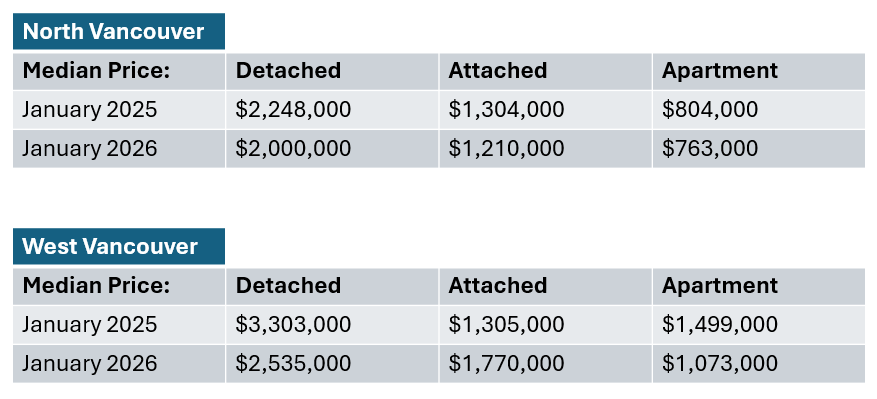
For many buyers, especially financially qualified ones, the North Shore is currently a favourable market to buy because:

  • Inventory is elevated and sales are below historical norms, creating buyer leverage.

  • Prices have softened or stabilized compared with recent highs.

  • Mortgage rates are more predictable and lower than in the past year.

  • Forecasts suggest modest market improvement ahead, so buying before broad demand re-emerges may be advantageous.

Read

Why the Next 60 Days Matter for Sellers

Historically, the first quarter of the year offers a unique window of opportunity for home sellers—and the data this year reinforces that pattern.

As shown in our current North and West Vancouver listing graph, the number of active residential listings at the start of January is materially lower than what we consistently see as we move toward spring and summer . This is not an anomaly. It is a seasonal trend that repeats itself year after year.

Less Competition Means More Attention

With fewer homes on the market right now, well-priced properties face less competition for buyer attention. Buyers who are active in January and February are typically motivated, informed, and prepared to act—often because they chose not to wait for the busier spring season.

Inventory Predictably Rises as Spring Approaches

The historical data clearly shows that listing counts climb steadily from late winter through early summer. As inventory rises, sellers are no longer competing with dozens of alternatives—they are competing with hundreds. More choice for buyers inevitably means longer decision cycles and increased pricing pressure.

Early Sellers Often Control the Narrative

Listing before the seasonal surge allows sellers to establish value without being influenced by a flood of comparable homes. In many cases, this translates to stronger showing activity and cleaner negotiations, simply because buyers have fewer substitutes.

The Takeaway

The next 60 days represent a strategic selling window:

  • Inventory is still low

  • Buyer demand is present

  • Competition will only increase from here

For homeowners considering a move this year, timing can be just as important as pricing and presentation. Acting before the spring inventory wave arrives can meaningfully improve positioning in the market.

Read

Understanding Your Property Assessment — And What It Means in 2026

Each January, homeowners across British Columbia receive their annual property assessment, and with it often comes confusion. Many people wonder: Is this what my home is really worth? The short answer is — not necessarily.

Assessed Value vs. Market Value

In British Columbia, property assessments are prepared by BC Assessment and reflect market value as of July 1 of the preceding year. That timing is critical.

A REALTOR®’s opinion of value reflects today’s market conditions, while your assessment is based on a snapshot from roughly six months earlier. In changing markets, this timing gap can create noticeable differences between assessed value and current market value.

Why Assessed Values and Market Values Differ

There are two main reasons:

1. Mass appraisal methodology
BC Assessment uses a mass appraisal system. Values are derived primarily from MLS® sales data within neighbourhoods or strata complexes, rather than individual property inspections. This broad approach is effective for taxation purposes but does not account for unique features, renovations, condition, or micro-market influences.

2. Time lag
Your 2026 assessment reflects estimated market value as of July 1, 2025 — not today. When markets shift, assessed values may lag behind real-time pricing.

What Assessments Are Really For

Market-value assessment is widely considered the fairest way to distribute the property tax burden across homeowners. However, it is important to understand that assessed value is not designed to be a precise indicator of what your home would sell for today.

Key Definitions

  • Market Value:
    The price expected if a reasonable amount of time is allowed to find a purchaser, and both buyer and seller are fully informed.

  • Assessed Value:
    The most probable price an unencumbered property would have sold for on the open market as of July 1 of the preceding year.

What’s Happening With 2026 Assessments

According to BC Assessment, the cooling housing market is now being reflected in 2026 values. Many homeowners across the Lower Mainland are seeing assessed value decreases ranging from 0% to approximately 10%, based on July 1, 2025 valuations.

In response to these changes, the British Columbia Ministry of Finance has also adjusted the B.C. Homeowner Grant threshold for the first time in six years. For 2026, the threshold has been reduced to $2.075 million, down from $2.175 million last year, aligning with lower assessed values across Metro Vancouver.

Why This Matters to You

A lower assessed value does not automatically mean lower property taxes, as taxes are determined by municipal budgets and tax rates. However, assessments do affect eligibility for programs such as the homeowner grant and provide insight into broader market trends.

If you are considering selling, refinancing, or simply want to understand your home’s current value, an assessment should be viewed as one data point — not the full picture.

As always, we are happy to provide a current market evaluation and context specific to your property and neighbourhood.

Read
Categories:   #IMHOME CONTEST | Ambleside, West Vancouver Real Estate | Annual Pumpkin Patch | Blueridge NV, North Vancouver Real Estate | Boulevard Real Estate | Boulevard, North Vancouver Real Estate | building | canuck place adventure challenge | Capilano Highlands, North Vancouver Real Estate | Capilano NV, North Vancouver Real Estate | Central Coquitlam, Coquitlam Real Estate | Central Lonsdale, North Vancouver Real Estate | Coal Harbour, Vancouver West Real Estate | Common Property | conquer cancer lynn valley, ride to conquer cancer | Deep Cove, North Vancouver Real Estate | Dollarton, North Vancouver Real Estate | Downtown VW, Vancouver West Real Estate | Dundarave, West Vancouver Real Estate | False Creek North, Vancouver West Real Estate | Forest Hills NV, North Vancouver Real Estate | Grouse Woods, North Vancouver Real Estate | habitable area | Hamilton, North Vancouver Real Estate | Heritage Woods PM, Port Moody Real Estate | Indian River, North Vancouver Real Estate | interest rates | Lions Bay, West Vancouver Real Estate | live in lynn valley | Lower Lonsdale, North Vancouver Real Estate | Lynn Valley, North Vancouver Real Estate | Lynnmour, North Vancouver Real Estate | Maintenance Fees | Municipality | North Vancouver Real Estate | Northlands, North Vancouver Real Estate | Oil Tank Removal | permits | Princess Park, North Vancouver Real Estate | pumpkin patch 2012 | Queensbury, North Vancouver Real Estate | Real Estate | Renfrew VE, Vancouver East Real Estate | Roche Point, North Vancouver Real Estate | Strata | Strata Lot | Strata Property Act | Tempe, North Vancouver Real Estate | Unit Entitlement | Upper Lonsdale, North Vancouver Real Estate | VNVED, North Vancouver Real Estate | Westlynn Terrace, North Vancouver Real Estate | Westlynn, North Vancouver Real Estate
Reciprocity Logo The data relating to real estate on this website comes in part from the MLS® Reciprocity program of either the Greater Vancouver REALTORS® (GVR), the Fraser Valley Real Estate Board (FVREB) or the Chilliwack and District Real Estate Board (CADREB). Real estate listings held by participating real estate firms are marked with the MLS® logo and detailed information about the listing includes the name of the listing agent. This representation is based in whole or part on data generated by either the GVR, the FVREB or the CADREB which assumes no responsibility for its accuracy. The materials contained on this page may not be reproduced without the express written consent of either the GVR, the FVREB or the CADREB.